
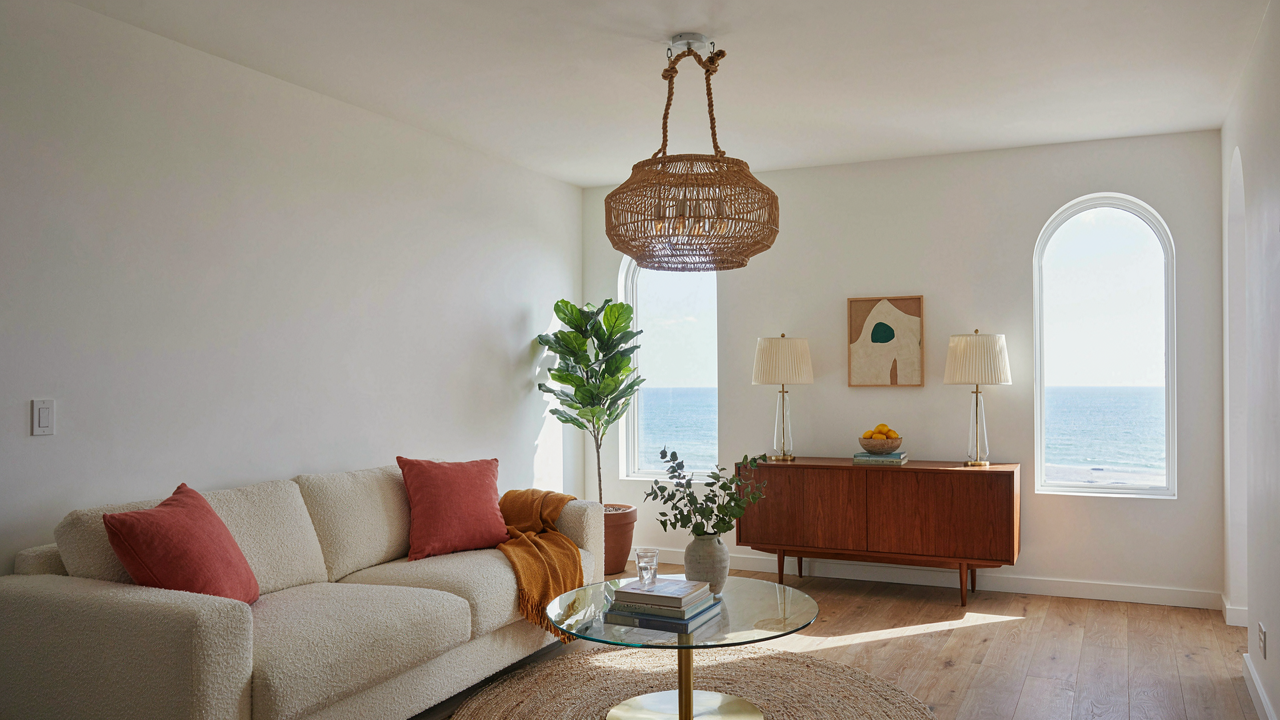
The Rattan Paradox: More Than Just Woven Warmth

How Rattan Actually Diffuses Light
You want rattan because it signals relaxation and coastal authenticity. That’s not the real reason to use it. Rattan works because its weave interrupts direct light rays through physical obstruction, scattering photons across a wider surface area rather than allowing them to concentrate in harsh pools. This is diffusion in optics terms, and it’s mechanical, not aesthetic.
Rattan’s fiber structure has natural gaps. When light hits these gaps at angles, it bends and spreads instead of projecting a defined shadow. A standard 40-watt pendant wrapped in rattan produces the same lumen output as an unwrapped pendant, but distributes that light across a 180-degree radius instead of a 60-degree cone. The effect feels softer because it is softer—lower intensity per square inch on any single surface.
Creating Depth Through Controlled Shadows
The advice to use rattan for “ambiance” misses the point. Shadows aren’t the absence of light; they’re the presence of contrast. Rattan creates shadow play by producing multiple shadow layers at different intensities, which human eyes read as depth rather than flatness.
Position a rattan pendant 18 inches from a textured coastal wall. The primary shadow from the rattan frame appears sharp and defined. The secondary shadow cast by individual rattan fibers appears softer, blurred behind it. A third layer emerges from gaps in the weave where light bleeds through unobstructed. These stacked shadow densities compress visual distance and make a small cottage interior feel larger. Place fixtures at varying heights—pendant at 72 inches, table lamp at 28 inches, floor lantern at 12 inches—to maximize shadow depth across the room.
Glass: Not Just Clarity, But Controlled Dispersion

Seeded And Frosted Glass: Manipulating Light Output
You want glass in a coastal cottage because it signals taste and expense without saying either one out loud. The real lever is that glass isn’t a passive material—it’s a tool for controlling how much light actually reaches your eye. Seeded glass contains bubbles trapped during manufacturing. Those bubbles scatter light in random directions instead of letting it pass straight through. Frosted glass uses an etched or sandblasted surface to achieve the same scatter effect. Both reduce glare and soften the source, which is why they work in cottage spaces where direct brightness reads as jarring.

The mechanism matters more than the aesthetic. When a bare bulb behind clear glass throws sharp shadows and creates eye strain, seeded or frosted glass in front of it becomes the filter. Light still escapes but diffuses across a wider area. This isn’t magic—it’s geometry. The more surface irregularity on the glass, the more random the light paths become. In cottage lighting, this diffusion means you need fewer fixtures to cover the same space without the flat, clinical feel of direct illumination. The fixture placement stays the same, but the perception of the light changes completely.
Refraction Principles: Light Bending For Ambiance
Refraction is a physics term meaning light bends when it passes from one material into another at an angle. Map this onto coastal cottage lighting and you get intentional control over where light pools and where shadow falls. The angle of the glass surface, its thickness, and its material density all dictate how much the light bends and where the beam spreads. Most design advice skips this and just says put glass somewhere it looks nice. That’s incomplete. The actual work is choosing glass shapes and surfaces that bend light into the corners you want lit and away from the areas you want to keep dim.
Beveled glass edges refract light into visible rainbow dispersal, which reads as expensive restraint in a cottage context. Curved glass surfaces bend light more aggressively than flat ones, concentrating beams or spreading them depending on whether the curve bulges outward or inward. A simple protocol: place your light source first, then choose glass that bends its output toward task areas and away from seating. Test the fixture at dusk before committing to installation—refraction changes perception, and the wrong angle makes a room feel smaller or colder than intended.
The Coastal Chandelier Code: Elevating Overhead Illumination

When Scale Betrays Your Space
You want the chandelier to do the work for you—to announce taste without effort. That’s backwards. Scale is load-bearing architecture, not decoration. Borrow the concept from structural engineering: overhead fixtures carry visual weight the same way a beam carries physical weight. Too much fixture in a 9-foot cottage ceiling creates oppression, not elegance. Too little disappears into context.

Measure your ceiling height first, then apply this formula: fixture diameter should not exceed one-twelfth of the room width. A 12-foot-wide cottage bedroom demands a chandelier no wider than 12 inches. Placement matters equally—center it over the primary seating or dining zone, never the architectural dead zone between areas. Spacing a chandelier off-center reads as either accidental or salvaged, neither of which lands in coastal cottage design.
Rattan Wrapped Around Clarity
The mistake most people make is treating rattan and glass as competing aesthetics that need balancing. They don’t. Rattan absorbs and diffuses; glass transmits and focuses. Pair them by letting each do its job without apology. A clear glass bowl with rattan wrapped around the support structure creates a hierarchy: the light source remains visible and functional while texture softens the fixture’s industrial skeleton.
Rattan material degrades under salt air and humidity without proper finish. Use kiln-dried rattan sealed with marine-grade polyurethane, not raw material. Glass components perform better in satin or frosted finish rather than high-gloss, which creates glare reflection typical of unfiltered coastal light. Install these fixtures in dining areas or entryways where you control dust accumulation—not in bathrooms where steam accelerates deterioration of the binding that holds rattan to its frame.
Beach House Lights: Beyond The Obvious Nautical Niche

Industrial Textures Meet Organic Forms
You want permission to break the rules without looking like you don’t understand them. That’s the real reason you’re reading this section. The mechanism at work here is contrast, borrowed from visual design theory: opposition creates visual weight and stops the eye. Rattan diffusers paired with raw steel fixtures don’t cancel each other out. They amplify. The softness of woven fiber against hard metal creates tension that reads as intentional, not confused.

Most coastal lighting advice stops at “rustic plus refined.” That’s incomplete. The real move is pairing materials with opposing surface qualities. Matte rattan absorbs light; polished brass or blackened steel reflects it. A woven pendant hanging from a rigid industrial bracket works because the contrast registers as deliberate craft, not accident. The viewer senses you chose this collision. Light passes through the rattan differently than it would through glass or fabric, creating shadow patterns that prove the pairing was thought through.
Objects With Actual History
Found objects as light sources isn’t about personality or story. It’s about optical function. A weathered glass fishing float or salvaged brass porthole performs work: it refracts, reflects, or diffuses light in ways mass-produced fixtures cannot replicate. The geometry is wrong for standard production. That wrongness becomes your advantage. When light hits an irregular or aged surface, it scatters unpredictably, creating depth that flat diffusers miss.
Source objects with dense material composition and uneven surfaces. A vintage factory pendant with visible patina diffuses warm light unevenly, which reads as richer than uniform distribution. A reclaimed ship’s lantern with salt-weathered glass filters light through actual corrosion. Integrate these into your fixture by rewiring them yourself or commissioning a lighting specialist who understands electrical safety codes for your region. The object becomes functional only when electricity runs through it safely and deliberately.
Coastal Pendant Lighting: The Art Of Layered Illumination

Cluster Placement And Height Variation
You want pendants to look effortless, which means you’re actually afraid they’ll look random or cheap. The mechanism is contrast. In architecture, layering uses depth to create visual interest without clutter. Coastal pendants work the same way. Group three pendants at different heights over a kitchen island or dining table. The lowest hangs 12 to 15 inches below the upper ones. This creates shadow and sight lines that make a small room feel intentional, not sparse.

Spacing matters more than design. Place pendants 18 to 24 inches apart horizontally, then stagger the drop lengths by 6 to 8 inches. Rattan shades diffuse light unevenly, which is the point. Uneven diffusion reads as natural. Use clear or frosted glass bases to catch and scatter light down and sideways. This prevents the dead-spot problem where one centered pendant leaves corners dark.
Task Meets Ambient In One Fixture
Everyone says pendants should look pretty. That’s incomplete. A pendant must pull double duty or it’s decorative waste. The real work is overlapping task lighting coverage with ambient glow. Task light targets the work surface directly. Ambient fills the room without harsh shadows. Coastal pendants with glass bottoms and rattan sides do both because the rattan blocks direct light downward while glass scatters it side to side.
Install pendants 30 to 36 inches above countertops for eating surfaces, 36 to 40 inches for active work zones. At these heights, the fixture becomes your primary light source without creating glare on countertops or in eyes. Pair this with one recessed light or wall sconce on a different circuit. You control task light with the pendants, ambient with the backup source. This separation is what makes coastal cottages feel lit intentionally rather than lit by default.
The Beachy Chandelier Blueprint: Defying Grandeur For Intimacy

When A Smaller Fixture Reads Larger
You want a chandelier that makes your cottage feel intentional, not like you bought it from a hotel surplus warehouse. Here’s what most people miss: a smaller fixture actually expands perceived space because it doesn’t compete with the room’s geometry. In coastal cottages with lower ceilings, a 20-inch diameter rattan or glass chandelier positioned at the right drop creates visual rhythm without crushing the space. The mechanism is psychological anchoring. Your eye registers the chandelier first, then measures the room relative to it. A massive fixture trains your eye downward and inward. A proportional one leaves the perimeter visible, making walls feel farther away.

Rattan chandeliers work here because their open structure doesn’t create visual density. Light passes through the material instead of reflecting off a solid mass. Glass components amplify this effect by maintaining sight lines beyond the fixture itself. Most coastal lighting advice recommends “statement pieces,” which is lazy thinking. The real move is choosing a fixture that occupies physical space without occupying visual space. Position the chandelier 7 to 8 feet from floor to bottom of fixture in rooms under 9 feet tall. This maintains headroom perception while centralizing light distribution. That distance is the protocol. Measure before you buy.
Light As A Distributed Field, Not A Point Source
Physics teaches that light radiates outward in a field, not like a laser beam aimed at one target. Apply that to coastal cottage design: your chandelier should scatter illumination across the room rather than pool it below. A rattan cage with multiple glass shades or open sides achieves this because light bounces off the rattan strands and disperses before reaching surfaces. A closed dome chandelier concentrates light downward and wastes the potential for ambient fill.
The specifics matter. A 40-watt equivalent LED bulb in a rattan pendant scatters light more effectively than the same wattage in frosted glass alone. The rattan acts as a diffusion layer. Position your chandelier slightly off-center in open-concept spaces to push light into corners that other fixtures miss. This transforms the fixture from a decoration into a functional tool. Most people center everything in the middle of the room and wonder why corners feel dead. Off-center placement exploits the natural field dispersion of light and requires no additional fixtures.
Coastal Ceiling Light: The Unsung Hero Of Room Shaping

Flush Mounts: Maximizing Ceiling Height
You want your cottage to feel bigger than it actually is. That’s the real reason you care about flush mounts. Ceiling height operates on the same principle as real estate value: scarcity creates perception. A flush mount sits tight against the ceiling, eliminating the dead air gap that semi-flush and pendant fixtures create. In a cottage with eight-foot or lower ceilings, this gap collapses the room psychologically. Rattan flush mounts compound the benefit because the woven texture draws the eye upward rather than down, using the fixture itself as a visual anchor that extends the sight line.

The common mistake is choosing a flush mount too large for the space. Cottage rooms are typically compact, and oversized fixtures dominate the plane overhead instead of receding into it. Select a rattan flush mount with a diameter no larger than one-twelfth of the room’s longest dimension. Glass panels integrated into the design multiply the effect because light passes through rather than stopping at the fixture. This creates ambient illumination that feels sourced from the ceiling itself, not hung from it.
Semi Flush Options: Adding Subtle Dimension
Semi-flush fixtures drop four to twelve inches below the ceiling, creating intentional separation where flush mounts eliminate it. This space serves a mechanical function: it allows air to circulate around the fixture, which matters in coastal environments where salt air accelerates corrosion. The separation also creates a shadow line that adds visual depth without the sculptural weight of a pendant. In a cottage, this is the difference between a flat, generic ceiling and one with actual architecture.
Rattan semi-flush designs work because the material breaks up light diffusion across the drop distance. Instead of a solid plane of light, the woven gaps create rhythm. Pair a semi-flush with glass elements that filter and soften the glow, and you’re not just adding illumination, you’re adding a functional ceiling detail that costs only inches of headroom. The depth created by the drop makes the room feel intentional rather than makeshift.
Avoiding The “Theme Park” Trap: Authentic Coastal Light Fixtures

Where Handcrafted Pieces Come From
You want proof that you care about authenticity without actually hunting for it yourself. Here’s the mechanism: mass-produced coastal fixtures fail because they copy the aesthetic of handcrafted work without the constraint that created it. Real constraint drives design. A glassblower working with rattan doesn’t add unnecessary detail because time and material cost demand economy. A factory replicating that piece adds ornament to justify the markup. Buy from makers who work in their material, not designers who license designs to manufacturers. This means regional glassblowers, studio potters who make ceramic lamp bases, and metalworkers who hand-forge brass components for fixtures. The Atlantic coast has documented glassblowing traditions in Maine and New Hampshire. Local makers sell directly or through galleries that vet their process. You verify by visiting studios or requesting production photos showing the maker’s hands and workspace. Skip Etsy stores shipping nationally with identical inventory. One handcrafted coastal fixture requires three months of searching. It should.

The sourcing protocol matters more than luck. Identify three regional makers in your state working in glass or metal. Request a studio visit or Zoom call to see their process. Ask which materials they source locally and which they import. Commission a custom fixture if your budget allows, even if modest. This teaches you why authentic pieces cost what they do and prevents future disappointment with mass-market imitations.
Reclaimed Materials Speak Louder Than New
Vintage and upcycled elements work because they carry use history that new materials cannot fake. Architecture calls this “patina” but the real mechanism is signal cost: a corroded brass fixture signals decades of salt air exposure, which proves coastal authenticity through expense of time, not money spent today. A new fixture polished to look weathered is a lie you see through instantly. Salvage yards, architectural salvage dealers, and estate sales provide genuine pieces. Reclaimed brass, copper, and iron fixtures from mid-century coastal homes work into modern cottages without contradiction. Glass with actual age marks and slight imperfections becomes superior to perfect new glass because the imperfections are evidence.
- Architectural Salvage Dealers: Regional dealers source from demolished homes and renovations. Verify the fixture’s origin region and verify it endured salt exposure or similar coastal conditions.
- Estate Sales In Coastal Towns: Search Massachusetts, Rhode Island, and Connecticut coastal town estate sale listings. Fixtures from homes built 1950-1980 contain authentic materials and brass uncoated with protective lacquer.
- Antique Glass Suppliers: Dealers specializing in vintage glassware stock original coastal hotel and inn lighting. These pieces have documented provenance and show actual use wear rather than artificial patina.
- Reclaimed Brass And Copper: Metalworking suppliers in port cities source brass components from decommissioned boats and fishing equipment. This material already carries salt corrosion patterns.
- Local Restoration Specialists: Electricians and lighting specialists who restore historic coastal homes know salvage sources and can source fixture components without selling complete collections at inflated prices.
Upcycled fixtures require one constraint to work: the original object must have functioned in a related context. A reclaimed maritime light from a fishing boat becomes coastal cottage lighting. A repurposed factory spotlight becomes pretentious. Pair reclaimed elements with contemporary rattan or glass work to avoid museum stiffness. The goal is evidence of place, not evidence of shopping at the right store.
The Coastal Lighting Ideas Manifesto: Beyond Trends, Towards Timelessness

Salt Air Requires Different Rules
You want to believe your lighting choice will last. It won’t, not without accounting for the actual environment you’re installing into. Coastal lighting operates under the same degradation principle as material science calls “corrosion resistance”—salt accelerates oxidation of metals, UV breaks down polymers, and moisture penetrates finishes. A rattan or glass fixture that works inland fails on the coast because you ignored the mechanism: salt spray doesn’t just discolor, it fundamentally alters material structure over months, not years.

The common advice here is generic maintenance tips. Wrong. You need fixtures rated for salt-spray environments, meaning they’ve passed ASTM B117 testing or equivalent. Brass tarnishes despite what Instagram shows you. Powder-coated steel rusts through the finish. Glass remains stable because it’s already oxidized, but its frames and hardware determine longevity. Select materials that have already surrendered to the environment rather than fighting it. Rattan requires marine-grade sealant reapplied annually, not “as needed.”
Quality Compounds Over Time
The gap between a thirty-dollar fixture and a three-hundred-dollar one isn’t aesthetics—it’s material specification. A cheap rattan pendant uses agricultural-grade rattan wrapped around standard wire; a quality coastal version uses kiln-dried marine-grade rattan with stainless steel components and sealed joints. This distinction means the cheap one degrades in two seasons while the quality one lasts eight to ten years. Fads die faster than fixtures. Investing in timelessness means buying pieces engineered for salt exposure, not pieces that photograph well.
Most people reverse this calculus. They buy trendy, replace it frequently, and call it “updating the space.” That’s waste disguised as preference. A single well-specified rattan and glass fixture costs more upfront but eliminates replacement cycles. The mechanism is compound durability: each year a quality fixture survives saves you the cost of replacement plus installation plus decision-making time. Choose fixtures with replaceable components—sockets, cords, hardware—so you extend the lifespan of the frame itself rather than discarding the entire assembly when one element fails.
The Real Obstacle Isn’t Finding The Right Fixture; It’s Your Inability To See Light As An Active, Atmospheric Ingredient

Most people treat lighting like furniture. You pick a thing, you mount it, you flip a switch. That’s why your cottage still feels flat despite the rattan and glass. Light isn’t decoration. Light is the primary material that shapes how a room makes you feel. Walk through your space at dusk today and notice where shadows fall. Notice what feels alive and what feels dead. That observation rewires how you’ll buy, place, and use every fixture going forward. Your cottage doesn’t need better lighting. It needs you to stop decorating rooms and start designing experiences.