
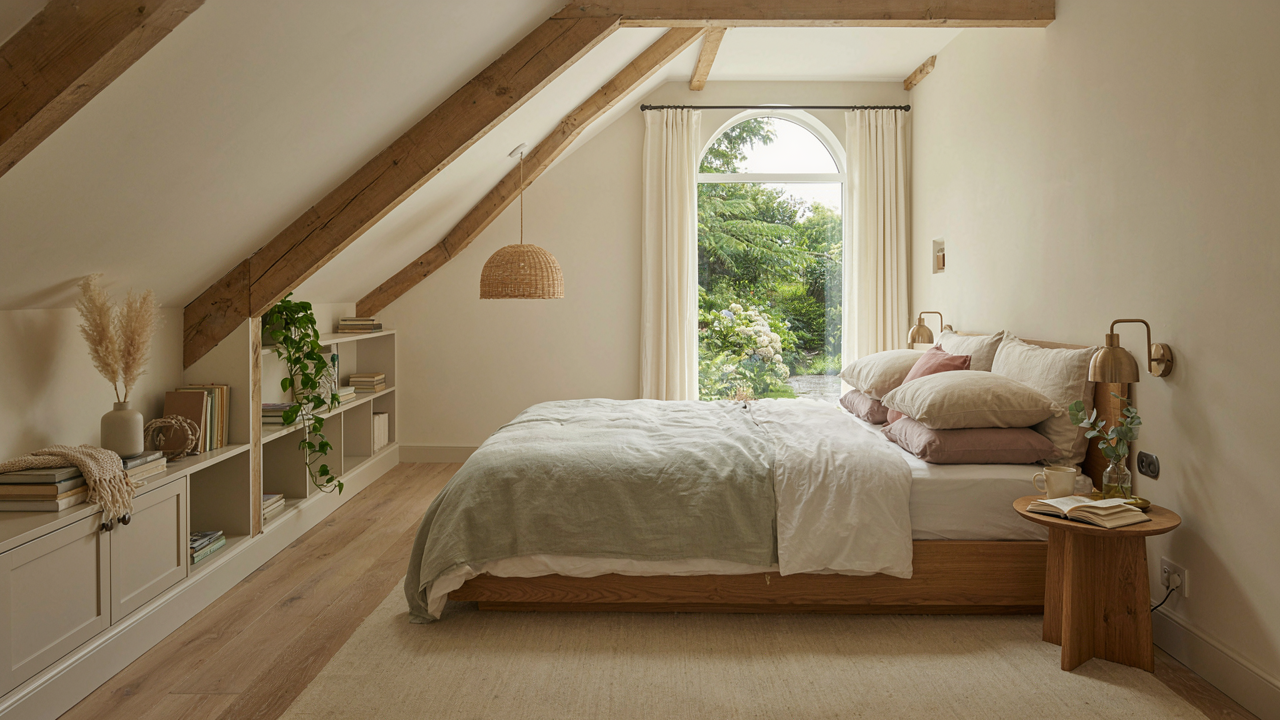
The “Sloped Ceiling Sanctuary” Protocol: Reclaiming Overhead Space

Hidden Storage Above The Slope
You’re worried about wasting money on a bedroom that feels cramped. The real mechanism: sloped ceilings create dead zones. These zones sit above eye level but below usable headroom. That’s inventory space you’re already paying for but leaving empty. Cottages with pitched roofs generate triangular pockets on both sides of the ridge. You access them through the wall itself, not from the floor.
Built-in storage along the slope works because it follows the ceiling line instead of fighting it. Install shelving or cabinets that run parallel to the angle. Use the space behind the headboard or along the low wall where ceiling height drops below six feet. This keeps furniture footprint minimal while capturing what would otherwise be dead air. The storage becomes invisible from bed level, so the room reads as uncluttered.
Lowering Perceived Ceiling Height With Intent
This sounds backwards, but smaller perceived ceilings make sloped rooms feel intentional rather than constraining. Use wall-mounted fixtures, not ceiling-hung pendants. Paint the sloped surfaces a shade darker than vertical walls. This boundary trick comes from Gestalt psychology, where contrast defines spatial edges. Your brain stops measuring upward when it hits visual resistance.
Soft layering creates horizontal breaks that interrupt vertical measurement. Floating shelves, a substantial headboard, or a fabric canopy mounted to the wall cuts the slope into sections your eye accepts as finished. Avoid tall vertical elements like floor lamps or narrow bookcases that emphasize height differential. The goal is making the sloped ceiling feel like part of the design intent, not a constraint you’re compensating for.
Soft Layers, Hard Data: Engineering Optimal Sleep Conditions

Natural Fibers Regulate Temperature Without Effort
You want this section to work because you suspect your bedroom isn’t actually comfortable, and you’d rather blame the design than fix the real problem. Temperature regulation is biology, not decoration. Your core body temperature drops two to three degrees Fahrenheit during sleep, and natural fibers either support or sabotage that mechanism depending on their fiber structure and moisture management properties.

Cotton, linen, and wool don’t regulate temperature through magic. Cotton absorbs and releases moisture quickly, preventing sweat accumulation. Linen wicks moisture away from skin faster than cotton and cools on contact. Wool regulates differently: it absorbs up to thirty percent of its weight in moisture without feeling wet, releasing that moisture gradually as air temperature shifts. In a cottage master bedroom with sloped ceilings that create microclimate zones, this matters. Different wall heights create different thermal environments. Position natural fiber layers where you actually sleep, not as decoration around the room.
Synthetic materials trap heat and moisture against skin. Polyester blends and microfiber hold sweat, which disrupts the temperature drop your body needs. Your sheets should be hundred percent natural fiber or you’re fighting biology every night. The specific weave matters more than thread count. A lower thread count linen sheet outperforms high thread count cotton because linen’s hollow fiber structure moves air faster. Buy linen for summer months and cotton for winter, then layer accordingly. Stop treating bedding as a single-category purchase.
Layering Creates Sensory Reduction, Not Decoration
Most people layer textiles wrong. They add more, thinking quantity equals comfort. Sensory deprivation in sleep means removing irritation, not adding softness. Each layer should solve a specific problem: moisture management, thermal regulation, or pressure distribution. The mechanism is simple: your nervous system can’t relax if it detects conflicting sensory signals. A scratchy top sheet creates constant micro-alerts that fragment sleep architecture.
Build your layer stack from skin outward. Base layer handles moisture: hundred percent cotton or linen. Second layer provides warmth without weight: lightweight wool blanket or cotton thermal blanket. Top layer acts as your thermal dial: quilt or comforter that you can push off or pull up without waking fully. Each layer should have a single job and do it well. Test each layer for pilling, fabric stiffness, and seam irritation before committing. A single scratchy seam against your neck eliminates everything else you’ve optimized. The goal is reaching a state where you stop noticing your bedding and your nervous system drops into parasympathetic mode.
Cottage Bedroom Inspirations: Beyond The Pinterest Board

Real Materials Beat Fake Every Time
You want your cottage bedroom to look authentic because you’re afraid people will know you cut corners. The mechanism is simple: mass-produced imitation materials fail because they lack the irregularity that signals age. Real wood has grain variation, inconsistent knots, and color shifts. Real linen wrinkles unpredictably. Real plaster shows trowel marks. Fake versions smooth everything out to machine perfection, which is the opposite of what cottages actually are.

Authentic materials cost more upfront but they age correctly. A genuine wood beam darkens unevenly over decades. Reclaimed brick shows mortar variation from the original mason’s hand. Linen bedding develops character through washing, not uniformity. When you choose real materials in a cottage master bedroom, you’re not paying for the look of age—you’re paying for materials that will actually age the way people expect them to.
Worn Textures Work Because Of Contrast
Texture communicates trust in design the same way vulnerability communicates trust in conversation. Psychological research on material perception shows humans read worn surfaces as evidence of use and longevity, not neglect. A sloped ceiling with visible beam edges, subtle cracks in plaster, or linen with uneven dye absorption all signal that something is genuinely old. That signal matters because it removes cognitive dissonance—your brain stops working to figure out if the room is authentic or staged.
The practical application: deliberately expose imperfect elements. Leave plaster slightly uneven near the ceiling. Choose bedding with visible weaving texture. Install hardware with visible patina rather than polished finishes. These aren’t mistakes to hide; they’re the actual vocabulary of cottage design. The worn texture does the persuasion work for you, so your eye stops searching for proof.
Master Bedrooms Decor Cottage: The Anti Clutter Imperative

Furniture That Earns Its Place
You want the room to feel spacious because you’re afraid it won’t, and clutter reads as failure. Here’s the mechanism: cottage master bedrooms with sloped ceilings have limited wall and floor real estate, so every piece must do multiple jobs or get cut. Minimalist furniture in cottages isn’t about asceticism—it’s about the math of the space. A low-profile bed with built-in drawers underneath stores what a traditional frame wastes. A single nightstand with deep shelves replaces a dresser. Wood pieces in natural finishes (oak, pine, walnut) visually recede against textured walls, making the room feel larger without adding volume. Form follows function here because function is survival in tight quarters.

The second move is scale matching. Cottage ceilings slope down, which means oversized headboards and tall furniture create claustrophobia. Opt for bed frames under 40 inches tall and nightstands proportioned to your actual reach distance, not generic hotel dimensions. Upholstered pieces work better than hard edges because fabric absorbs light and softens the geometry of a compressed space. This isn’t decoration—it’s physics applied to residential interiors.
Concealment That Actually Works
Visible storage is psychological noise, and noise kills rest. The common advice says “use baskets and open shelving,” but that just spreads the problem across more surfaces. Real serene spaces hide what they store. Cottage master bedrooms need built-in solutions because furniture placement is already dictated by the slope: a window here, a wall there, angled ceilings everywhere.
Install cabinetry that sits flush against eaves and follows the roofline angle. Custom built-ins are expensive upfront, but they’re cheaper than replacing furniture that doesn’t fit or rearranging a room three times. Undersized drawer units fit beneath sloped sections where traditional dressers can’t. Floating shelves anchored directly into studs behind the headboard eliminate leg space and store without the footprint tax. The protocol is simple: map your slope, measure twice, build in not out.
Bedroom Ideas Cottage Style: Strategic Lighting For Circadian Rhythm

Warm Light Spectrums For Evening Relaxation
You want this section to work because you’re tired of feeling wired at night, and you’re hoping better lighting will fix it without you changing anything else. Here’s the mechanism: your circadian rhythm operates on a biological timer that responds to light wavelength, not just brightness. Warm light (2700K or lower) signals your body to produce melatonin. Cool light (5000K and above) suppresses it. In a cottage master bedroom with sloped ceilings, layered fixtures let you shift the spectrum as evening progresses without rewiring the whole room.

Install dimmable warm bulbs in bedside sconces and overhead fixtures. Position them to avoid direct glare on your face after sunset. The goal isn’t mood lighting—it’s a deliberate suppression of blue wavelengths that keep your nervous system alert. Most people assume any dim light works the same. It doesn’t. A dimmed cool-white bulb still triggers wakefulness. Warm spectrum at low brightness creates the biological conditions for sleep onset.
Automated Blackout For Undisturbed Sleep
Blackout capability is not optional if you want consistent sleep architecture. Light leakage destroys REM sleep cycles regardless of how good your mattress is. In cottages, sloped ceilings create odd window angles and angles that standard curtains miss. Motorized blackout shades solve this without aesthetic compromise—they retract into the ceiling line during day and deploy fully at night, leaving no gaps.
Program your shades to close 30 minutes before your target sleep time. This creates a sensory reset that verbal or mental cues alone won’t trigger. Pair automated blackout with a smart plug on your bedside lamp so both actions happen together. The stacking matters: when darkness arrives on schedule, your body expects sleep. You’re not relying on willpower or memory. The mechanism is environmental compliance, not discipline.
The “Sensory Deprivation” System: Noise, Light, And Scent

Acoustic Dampening For True Quiet
You want silence because you think it signals luxury. What actually matters: your nervous system can’t recover if external noise keeps triggering alertness. Biology calls this the startle response. In a cottage master bedroom, the mechanism is identical—sound waves hit your eardrums, activate your amygdala, and prevent deep sleep cycles regardless of how tired you feel.

Most people use soft furnishings and hope. That’s incomplete. You need mass and air gaps working together. Mass stops mid-frequency noise from traveling through walls. Air gaps break the path of high-frequency sound. Mineral wool batts between wall cavities handle both. Cork underlayment under flooring absorbs impact noise from footsteps. The payoff isn’t comfort—it’s measurable REM sleep duration. Install acoustic materials before the drywall goes up if you can. If not, prioritize the wall facing the loudest external source first.
Neutralizing Rather Than Covering Odor
The common move is fragrance diffusers and scented candles. Wrong approach. You’re not eliminating the problem, just masking it with a second smell. Your olfactory system adapts to continuous scents within days anyway, so you’re chasing a strategy that fails. Odor neutralization works through chemistry, not psychology. Activated charcoal and baking soda bind to odor molecules instead of layering fragrance on top.
Place activated charcoal in shallow bowls near the bedroom entrance and corners where air stagnates. Replace every three months. Fresh bedding gets washed weekly in unscented detergent, not perfumed alternatives that add another competing odor. Ventilation matters more than any product—crack windows for ten minutes each morning. The goal is a neutral baseline, not a signature scent. This removes the sensory noise your brain processes while sleeping, allowing faster sleep onset and fewer micro-arousals during the night.
Bedroom Decor Ideas Wooden Bed: The Foundation Of Stability

Solid Wood Construction Matters
You want a wooden bed because it signals permanence. You’re tired of replacing furniture every five years. Here’s the mechanism: solid wood withstands stress cycles—the nightly compression and release of body weight—without degrading the joint integrity that particle board loses immediately. Hardwoods like oak and cherry have cellular density that absorbs impact. Softwoods like pine flex more but still outlast engineered alternatives by decades when properly constructed.

A wooden bed frame becomes the anchor point for your entire cottage aesthetic. The wood grain and natural color variations ground a room with sloped ceilings, preventing the space from feeling temporary or hotel-like. When you invest in solid construction, you stop fighting the furniture and start using it as a visual foundation for layering textiles and lighting around it.
Mattress And Pillow Alignment Works
Your mattress and pillows aren’t accessories to the bed frame—they’re load-bearing components of the system. A misaligned pairing creates pressure points that fragment sleep, which means you never recover from the day’s work. The real work happens in matching firmness levels: a soft mattress with a supportive pillow creates spinal curvature that disrupts rest, while the reverse keeps your neck in constant micro-tension.
- Medium-firm mattress with medium loft pillow: Creates neutral spinal alignment for most sleepers, reducing morning stiffness in cottage bedrooms with lower ceiling angles.
- Natural latex or innerspring cores: Both provide consistent support without off-gassing, unlike synthetic foam that deteriorates and smells for months.
- Down or buckwheat fill pillows: Down compresses to match your shoulder width; buckwheat maintains shape without the heat retention that disrupts sleep cycles.
- Mattress rotation schedule: Flip or rotate every three months to prevent body-weight indentation in high-pressure zones where you spend most nights.
- Pillow replacement every two years: Pillows compress and lose support faster than mattresses; old pillows force neck adjustment that compounds into shoulder tension.
Test the pairing on day one by lying on your side for ten minutes. Your spine should form a straight line from neck to hips, not a curve. If you adjust your pillow height within the first week, the pairing is wrong—send one piece back and try again.
Cottage Theme Bedroom: Nature’s Unseen Benefits

How Plants Actually Change Brain State
You want this room to feel restorative because you’re drowning in stimulus and need permission to decompress without admitting it. Here’s the mechanism: biology calls it biophilic response, a measurable shift in nervous system activation when humans encounter living systems. A cottage master bedroom with plants or views of natural elements doesn’t just look calmer. It triggers parasympathetic dominance, the physiological brake pedal your overloaded brain stopped using months ago.

The common advice stops at “add plants for aesthetics.” That’s incomplete. Window placement toward trees or gardens, living plants at eye level from the bed, and natural wood materials all work because they create consistent low-level sensory input that your brain categorizes as safe. This isn’t spiritual. It’s neurochemistry. The sloped ceiling of a cottage amplifies this effect by breaking up the visual monotony of standard rectangular rooms, forcing your gaze to engage with the space’s geometry rather than blank walls. Place one substantial plant in your direct sightline from bed, not as decoration but as a biological anchor.
Materials That Actually Breathe
Everyone talks about cottage bedrooms needing “natural materials,” then picks whatever looks right. That’s wrong. The mechanism is indoor air quality, not aesthetics. Wood, untreated linen, and wool genuinely offgas less volatile organic compounds than synthetic alternatives, but only if sourced correctly. A cottage master bedroom with sloped ceilings needs materials that regulate humidity naturally because roof proximity means temperature swings and condensation risk that flat-ceiling rooms avoid entirely.
Plaster over lath, untreated timber beams, and natural fiber insulation don’t just match the cottage aesthetic. They actively absorb and release moisture, stabilizing the microclimate your respiratory system encounters during eight hours of sleep. Stone or clay plaster on walls under sloped sections prevents mold growth better than drywall because it transpires. Specify materials with third-party certifications for low VOC emissions, not because it’s trendy, but because you spend a third of your life breathing this air. Your material selection directly controls whether your cottage bedroom restores you or slowly loads your system with toxins you don’t notice until months later.
Guest Bedroom Bookshelf And Bookshelf Guest Room: Curated Knowledge, Not Clutter

Books That Signal You Read
You want people to think you’re intelligent without having to prove it. Here’s what nobody says plainly: a bookshelf works like inventory management in retail. You stock only what moves. A cottage master bedroom bookshelf fails when it becomes a storage unit for books you’ll never open again. The mechanism is simple: visible books broadcast a message about who sleeps there. Make that message intentional or don’t bother.

Aim for fifteen to twenty-five books maximum on a bedroom bookshelf. Go deep on three to five topics instead of collecting one of everything. Architecture, nature writing, and design books work because they function as both decoration and reference. A guest notices quality over quantity immediately. One shelf of genuinely read books beats three shelves of unfinished purchases.
The Bookshelf As Room Narrative
A bookshelf tells the truth about who lives in a space, whether you plan for it or not. In a cottage master bedroom with sloped ceilings, the bookshelf becomes a focal point because the room geometry forces the eye there. Stock it with books that explain your actual interests, not books that perform a version of yourself for guests. Your selections create a subconscious narrative about taste and depth.
Pull books from your active rotation. Arrange them by color and size to create visual rhythm under low ceilings, then layer them horizontally to break monotony. Leave gaps between stacks. The bookshelf stops functioning as decoration the moment you fill every inch. The gaps matter more than the books because they signal restraint.
The Deconstructed Cottage: Unmasking True Comfort

Stop Treating Your Bedroom Like A Showroom
You want permission to keep less stuff because clutter makes you feel like you’re failing at adulthood. Here’s the mechanism: a cottage master bedroom works because it operates on scarcity, not abundance. Every object earns its place through use, not through aesthetic intent. This is the opposite of how most people decorate. Remove the performance anxiety first.
Function demands you strip away decorative excess that contradicts how you actually live. A sloped ceiling limits furniture placement anyway, so fighting it with oversized dressers creates visual noise and wastes floor space. Keep only what you touch daily: bed frame, two nightstands, one chair or bench at the foot. Everything else creates maintenance burden disguised as comfort.
What Actually Needs To Disappear
Most cottage design advice says to add “cozy elements” like throw pillows, wall art, and accent tables. That’s incomplete. The real work is identifying which elements you maintain versus which ones maintain you. A cottage master bedroom with sloped ceilings becomes a trap when you fill it with objects that need dusting, repositioning, or visual justification.
Start with inventory: walk through your room and mark everything you’ve touched in the last week. Anything unmarked is dead weight. Sloped ceilings already create natural visual interest, so decorative wall hangings become redundant clutter. Keep textiles functional, keep surfaces clear, keep lighting direct. The mechanism is restriction: fewer objects force better design decisions because you can’t hide behind volume.
The True Obstacle Isn’t Design, It’s Your Inability To Disconnect; Master That, And The Bedroom Follows

You can layer every textile and angle every beam perfectly. The bedroom still won’t work if your phone owns your attention. Your cottage master bedroom exists to reset you, not to impress you. Tonight, delete one app that doesn’t serve sleep. Tomorrow you’ll notice the sloped ceilings differently. Disconnection precedes design.