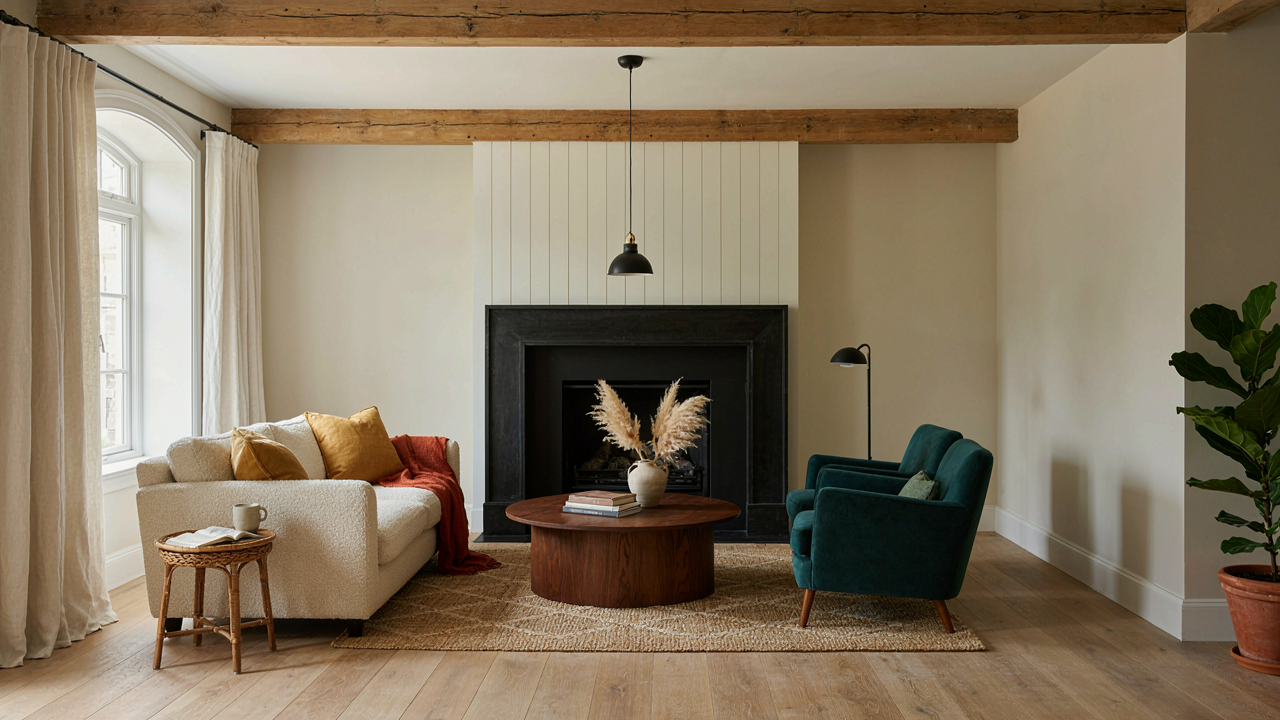
The Myth Of “Farmhouse Chic”: Why Most Designs Fall Flat

Mass Produced Materials Masquerading As Vintage
You want the status of owning something that looks like it came from another era, without the actual work or cost of sourcing it. Here’s the gap nobody mentions: modern rustic farmhouse fails the moment you introduce materials engineered to look old instead of materials that are old or genuinely weathered through function.
Big box retailers sell distressed wood that’s stained and scratched in a factory. Real farmhouse wood bears marks from actual use, load-bearing history, and decades of exposure. The difference isn’t subtle. A reclaimed beam shows asymmetrical patina, real nail holes, and wood movement from climate cycles. Reproduction distressing looks uniform, plastic, and dishonest.
Function Actually Drives The Aesthetic
Everyone says “form follows function,” but they don’t apply it here. Industrial design principle: constraints breed authenticity. A farmhouse wasn’t designed to look rustic. It was built to work. Heavy wood beams existed because they had to span open spaces and carry roof loads. Iron hardware wasn’t decorative, it held things together.
When you reverse-engineer the aesthetic without the functional logic, you get fake farmhouse. The real move is identifying what your space actually needs to do, then letting materials and structure emerge from that need. A room that requires storage gets built-in wooden cabinetry with iron hinges because those solve the problem, not because they photograph well. Function solved first makes the design land.
Raw Wood’s Unseen Power: Not Just A Texture, But A Narrative

The Grain That Tells Time
You want raw wood because it signals authenticity to people whose opinions matter to you. But here’s what actually works: wood grain and knots function like geological layers. Each ring, each imperfection, documents a specific year of growth. Reclaimed wood carries visible history—nail holes, saw marks, color variation from decades of exposure. This isn’t romantic. It’s evidence. Modern rustic farmhouse design weaponizes this evidence by displaying it prominently, making the material’s age impossible to ignore or fake.

The reason generic “distressed” finishes fail is they manufacture age without earning it. Real aged wood shows damage in patterns that make sense: wear concentrated on high-traffic edges, fading on surfaces that faced south, weathering that follows wood grain direction. When you source authentic reclaimed materials—barn wood, salvaged beams, deconstructed flooring—you get those patterns for free. Your room doesn’t look styled. It looks lived in because the materials actually have been.
Texture Beyond Touch
Wood’s tactile reality rewires how people experience a room before they consciously process it. Raw wood has actual tooth and variation on its surface, not the smooth uniformity of polyurethane coatings. This activates proprioceptive feedback: your nervous system registers the material as substantial. The scent profile matters equally. Fresh-cut raw wood releases volatile organic compounds that linger for months after installation. Old reclaimed wood holds scent differently—mineral, earthy, sometimes faintly smoky depending on its previous environment.
Most design advice treats sensory engagement as decorative flavor. Wrong. The olfactory system connects directly to limbic memory centers, bypassing conscious evaluation entirely. When someone enters a modern rustic farmhouse with exposed raw wood beams, their amygdala processes safety and age before their prefrontal cortex forms opinions. The specific action: leave wood unsealed or lightly sealed with matte finishes that preserve surface texture rather than creating glossy barriers between skin and material.
The Iron Protocol: From Industrial Utility To Enduring Form

Forged Integrity Strength And Longevity In Design
You want iron in your space because it signals permanence. Most design advice treats iron as decoration, a visual accent to soften with farmhouse charm. That’s backwards. Iron’s real mechanism comes from metallurgy: forged steel gains strength through compression and heat, creating internal density that prevents failure. Modern rustic farmhouse uses this same principle. Iron elements work because they’re built to last, not because they look aged.

Forged iron components hold their structure under stress. Blacksmith-welded frames, hardware, and brackets don’t weaken with time the way modern mass-produced fasteners do. When you choose hand-forged pieces over cast reproductions, you’re choosing materials engineered for load-bearing longevity. This isn’t aesthetic preference. It’s material physics. The iron holds the design together because the iron actually holds things together.
Visual Weight Anchoring Elements And Contrast
Heavy iron pieces ground a room. They sit at the bottom of visual hierarchy and pull the eye downward, creating psychological stability. The contrast mechanism works like this: raw wood offers warmth and visual lightness through grain variation and organic edges. Iron does the opposite—it’s dark, uniform, and dense. Place a wrought iron table base under reclaimed wood top and you’ve created tension that feels intentional, not accidental. The lightness only registers because the weight exists.
Iron anchors without dominating. A single forged iron beam across a ceiling, exposed and unfinished, prevents the whole room from floating upward into farmhouse cliché. Iron staircases, window grilles, and door frames work the same way. They break up expanses of drywall and wood by introducing visual gravity. The placement rule is simple: put iron where the room needs to stop moving. Put it at transitions—thresholds, corners, load points. That’s where forged integrity serves both structure and sight.
Modern Mountain House: Strategic Minimalism For Impact
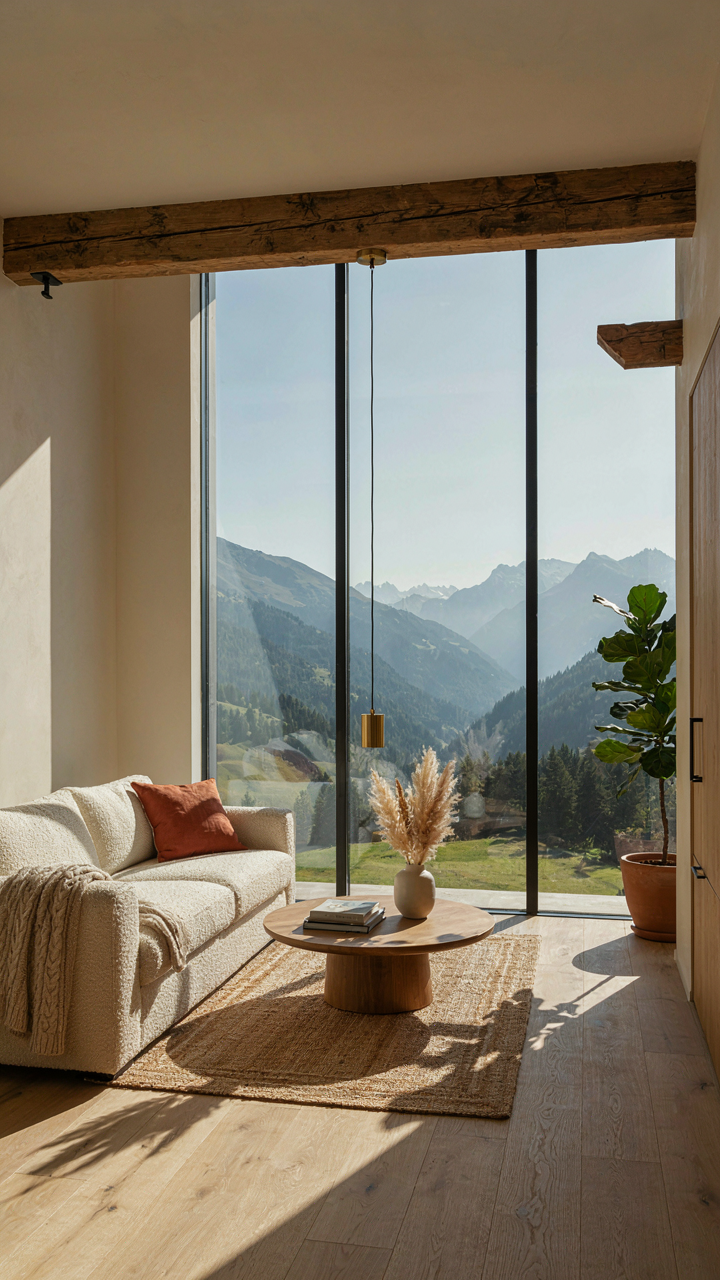
Empty Space As Design Currency
You want people to feel something when they walk in, and you think that means adding more. Wrong. The real mechanism here is scarcity. In design, what you remove creates the frame that makes what remains matter. Modern rustic farmhouse spaces that hit hardest aren’t cluttered with salvaged pieces and reclaimed wood just because those materials exist. They use negative space like a constraint, not a limitation.
Decluttering in this context isn’t about Marie Kondo aesthetics or minimalist purism. It’s about discipline. You keep raw wood beams visible because they’re structural and beautiful. You remove three decorative items to let one iron fixture command the room. The empty wall becomes as important as the one with shiplap. This approach forces every object to justify its presence through material quality or functional necessity.
Landscape As Interior Extension
Borrowed from site planning in architecture, the concept of visual continuity collapses the boundary between indoors and outdoors. Modern rustic farmhouse thrives when you treat the exterior view the same way you’d treat a material finish inside. A floor-to-ceiling window framing a tree line or pasture isn’t decoration. It’s part of the spatial volume of the room.
The practical move: position seating and sight lines toward the strongest view. If you have windows facing a field, valley, or treeline, orient your raw wood table or iron-framed seating area to activate that sightline. Remove interior elements that compete with the vista. Walls and trim recede when the landscape becomes the focal point. This is why modern rustic farmhouse works on actual farms and mountain properties but fails in urban apartments. The design depends on what exists outside the frame.
Open Airy Kitchen: The Ecosystem Of Culinary Flow

How Circulation Beats Square Footage
You want an open kitchen because you think it looks expensive and connected. The real reason to build it is efficiency. Borrow from biology: circulation is how organisms move nutrients and waste. In kitchen design, circulation means the path your body travels during food prep, cooking, and cleanup. A modern rustic farmhouse kitchen succeeds when you minimize backtracking and dead zones.

The work triangle (prep, cook, clean) is outdated advice. It assumes three fixed points. Modern kitchens demand fluid movement across the entire space. Raw wood counters and open shelving reinforce this because they remove visual barriers that slow your brain down. Iron fixtures mounted overhead don’t clutter floor space. Position your sink, stove, and prep area so you move forward, never sideways into obstacles. This isn’t about aesthetics. It’s about reducing cognitive load while you’re working.
Food Prep To Cleanup Without Friction
The metabolic pathway of a kitchen runs from ingredient storage to plate service to cleaning stations. Most kitchens break this chain with poor placement. Your prep zone needs raw wood counter space within arm’s reach of cold storage and your cutting tools. Cooking happens at the stove, but sauces, spices, and utensils must sit on open shelving or magnetic iron strips mounted at elbow height, not tucked away.
Cleaning is the bottleneck nobody plans for. Mount your sink with unobstructed access to both sides. Position a drying station adjacent to it, using iron racks to hang pots and cast iron skillets. This keeps them visible, accessible, and out of cabinet dead zones. The farmhouse aesthetic supports this workflow because open shelving and wall-mounted iron are the design language, not a compromise. Your movement through these three stations should trace one continuous loop, not require walking the same stretch twice.
The Un Decorated Kitchen: Simple Farmhouse Style Manifesto
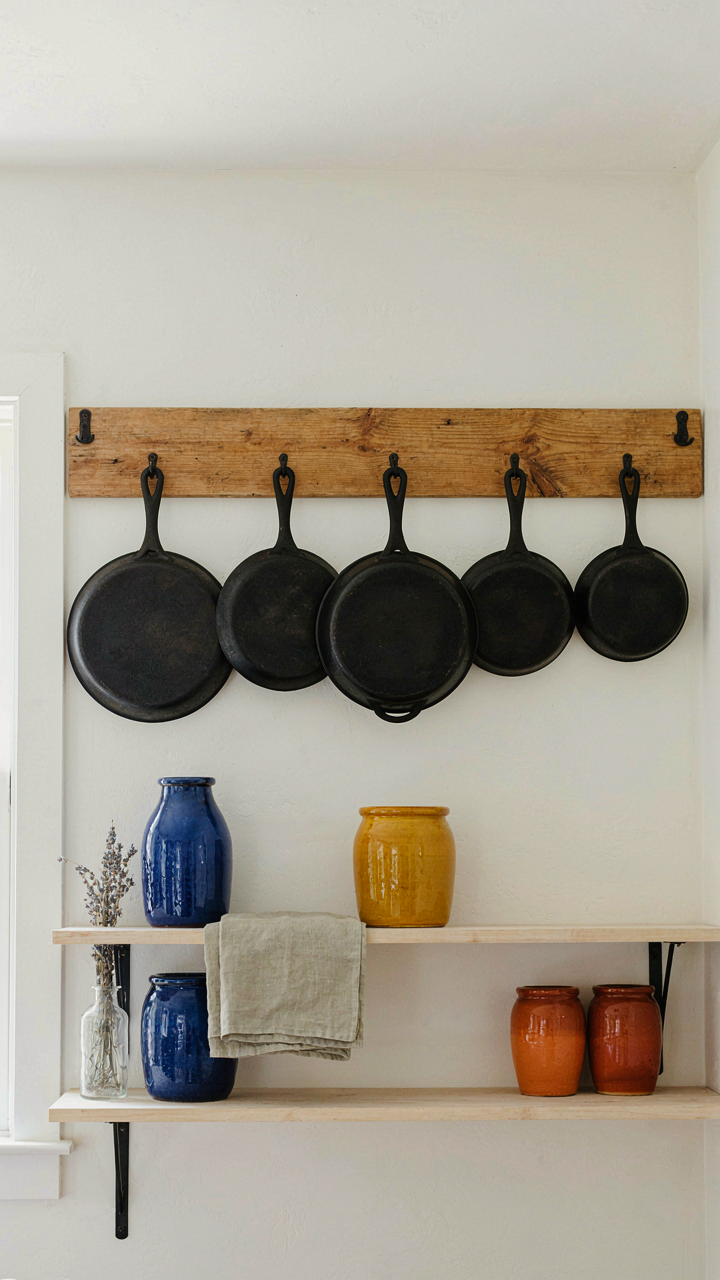
What Actually Belongs Here
You want permission to keep less because you’re secretly afraid you’re not sophisticated enough to curate properly. The mechanism is this: modern rustic farmhouse kitchens work because they apply constraint like a budget applies to spending. Remove what doesn’t function. What remains looks intentional instead of accumulated.

Most kitchens fail because owners treat empty counter space as wasted real estate and fill it reflexively. The farmhouse kitchen does the opposite. Every object earns its place through daily use or structural necessity. A cast iron skillet on the wall functions. A decorative copper mold does not. The discipline of elimination reveals the architecture underneath.
Tools That Earn Their Display
Industrial design borrowed the term “form follows function,” and farmhouse kitchens weaponize it. Hanging cast iron, ceramic crocks, and open shelving with working equipment aren’t decoration. They’re infrastructure that happens to look clean because it serves a purpose.
- Cast Iron Cookware: Hanging on walls or mounted via iron rods. Daily use justifies visibility. Patina develops naturally over years, creating authentic surface texture without artifice.
- Open Wooden Shelving: Displays bowls, jars, and serving pieces in regular rotation. Weight-bearing brackets in black iron anchor the aesthetic while supporting practical storage.
- Ceramic and Stoneware Crocks: Store dry goods, utensils, or flour. Neutral earth tones integrate seamlessly. Function as both containment and visual anchor points.
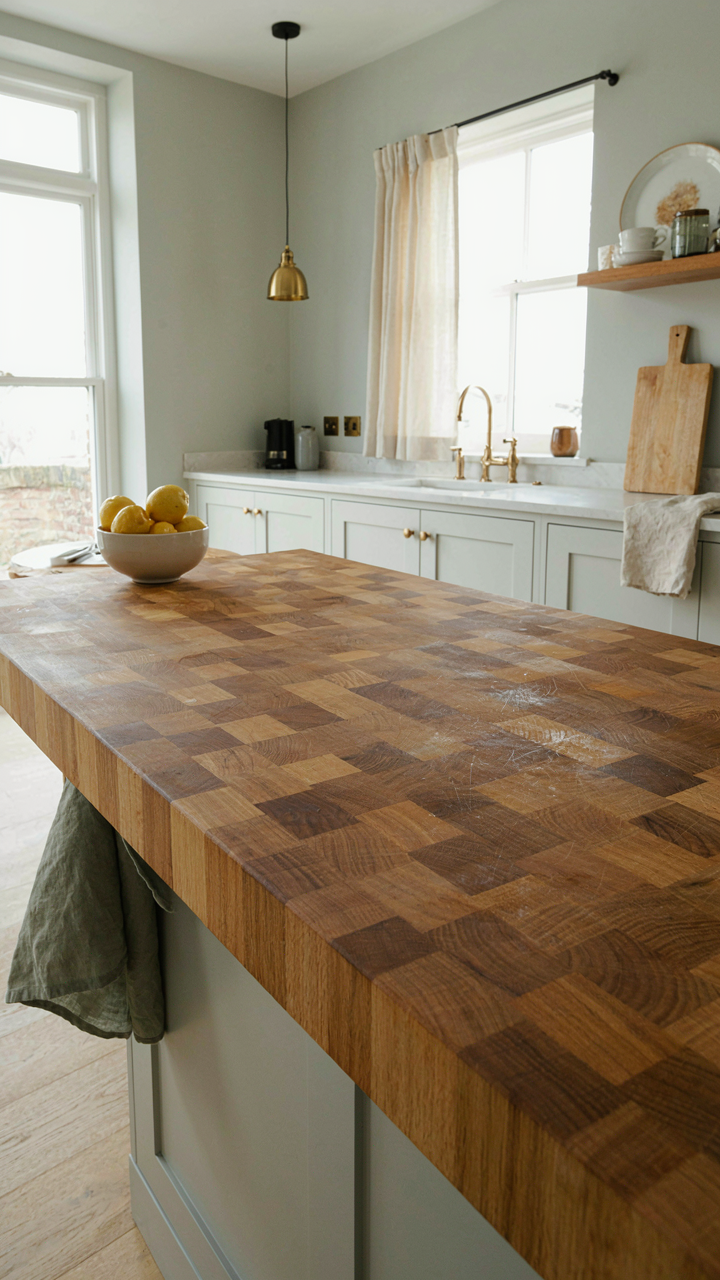
- Butcher Block Island or Counter: Raw wood work surface darkens with use and staining. Material itself becomes the finish. Serves prep, storage, and gathering simultaneously.
- Open Hooks and Rails: Mounted on shiplap or plaster walls. Hang dish towels, measuring tools, and aprons in arm’s reach. Iron hardware matches window frames and cabinet fixtures.
Visible storage solves two problems at once: you find what you need without opening cabinets, and the constraint of visibility forces you to own only what you actually cook with. Everything on display becomes accountable. Your kitchen stops performing and starts functioning.
Houses Aesthetic Kitchen: Orchestrating Visual Hierarchy

Where Your Eye Lands First
You want people to notice the intentional parts of your kitchen and skip over the mundane ones. That’s the real game. Visual hierarchy in modern rustic farmhouse kitchens works like contrast in photography: your brain identifies the brightest or most differentiated element first, then moves outward. A raw wood island with iron hardware doesn’t fight for attention—it commands it because nothing else in the space competes at that scale or material weight.

The mechanism is scarcity plus material honesty. Most kitchens distribute visual weight evenly across surfaces, which creates noise. Modern rustic farmhouse solves this by anchoring one dominant element—typically the island, range wall, or open shelving—in authentic materials like weathered timber or blackened steel, then letting everything else recede into neutral territory. Your focal point wins because it’s materially different, not because it’s decorated more heavily.
Building Depth Through Contrasting Materials
The common advice says “mix textures for interest.” That’s lazy. Texture layering in modern rustic farmhouse isn’t decoration—it’s structural contrast that your eye reads as depth and craftsmanship. Stone countertops next to raw wood next to matte black iron don’t just look good; they register as three distinct material families, which forces your eye to move through the space rather than stop at one plane.
Start with one primary material per zone: raw wood for the island base, stone or concrete for counters, iron for hardware and fixtures. Then introduce a secondary texture that opposes it—smooth stone against rough beam ends, polished metal against unfinished wood grain. The third layer is textiles: a linen runner on the floor, a cotton towel hung on an iron rod. Each layer sits on a different plane, and your brain reads that spatial separation as intentional design, not accident. This is where most kitchens fail: they add textures without positioning them to create actual visual distance.
Rustic Chic Kitchen Ideas: Beyond The Surface Level
Materials Built To Last Through Actual Use
You want a kitchen that looks intentional, not disposable—that’s the real fear underneath this section. Here’s the mechanism: in material science, stress concentration points determine failure. Raw wood and iron in modern rustic farmhouse kitchens fail at joints, fasteners, and transitions between materials. A butcher block countertop cracks not because of wood quality but because fasteners beneath it don’t move with seasonal wood expansion. Choose reclaimed or solid wood with visible grain variation. Avoid engineered veneers that separate when humidity cycles. Iron hardware needs hot-dip galvanizing or powder coating applied after fabrication, not before, so the coating bonds to raw metal instead of sitting on a factory oxide layer.

Laminate tops marketed as “farmhouse style” won’t survive five years in a functional kitchen. Real countertops—end-grain butcher block, soapstone, or raw wood sealed with food-grade finish—cost more upfront because they handle daily abuse and thermal shock. Cast iron cookware on a gas range expands and contracts violently; your counter materials need to accommodate that environment. Stainless steel and cast iron expand at different rates, so the junction between a range and countertop moves. Specify thermal breaks in the design or accept visible gaps as the mechanism that prevents buckling.
Patina As Design Intention, Not Accident
The standard advice here is backwards: patina isn’t something that happens to your kitchen. Patina is what you buy when you choose raw materials. Raw iron doesn’t rust randomly—it oxidizes predictably along grain boundaries and weld lines. Reclaimed wood doesn’t age evenly; it darkens based on which surfaces faced light and moisture. Modern rustic farmhouse succeeds when you stop fighting this and instead design for it.
Specify how patina develops by choosing materials that age visibly but safely. Raw steel shelving oxidizes into a protective layer within weeks, then stabilizes. Raw wood handles and brackets darken from hand oils and humidity, creating contrast against lighter surfaces. Oil finishes on wood require reapplication every year or two—this maintenance cycle is the mechanism that refreshes patina instead of letting it degrade into damage. Water stains on raw wood aren’t flaws; they’re evidence of use. The kitchen that ages well is the one where you selected materials that improve with visible wear, not materials that merely decay.
The Real Obstacle Isn’t Finding The Right Distressed Wood; It’s Escaping The Herd Mentality That Dictates Your Design Choices

Most people build a modern rustic farmhouse because Pinterest told them to, not because they actually want one. You absorb what everyone else is doing and call it taste. Stop copying the algorithm. Pick one element that genuinely moves you, then build backward from there. Ignore the rest. Your space doesn’t need permission from a design trend to feel alive. The homes that stick with you aren’t the ones that followed the rulebook perfectly. They’re the ones that broke it.