

Beyond Pinterest: Why Most Farmhouse Mudroom Lockers Fail
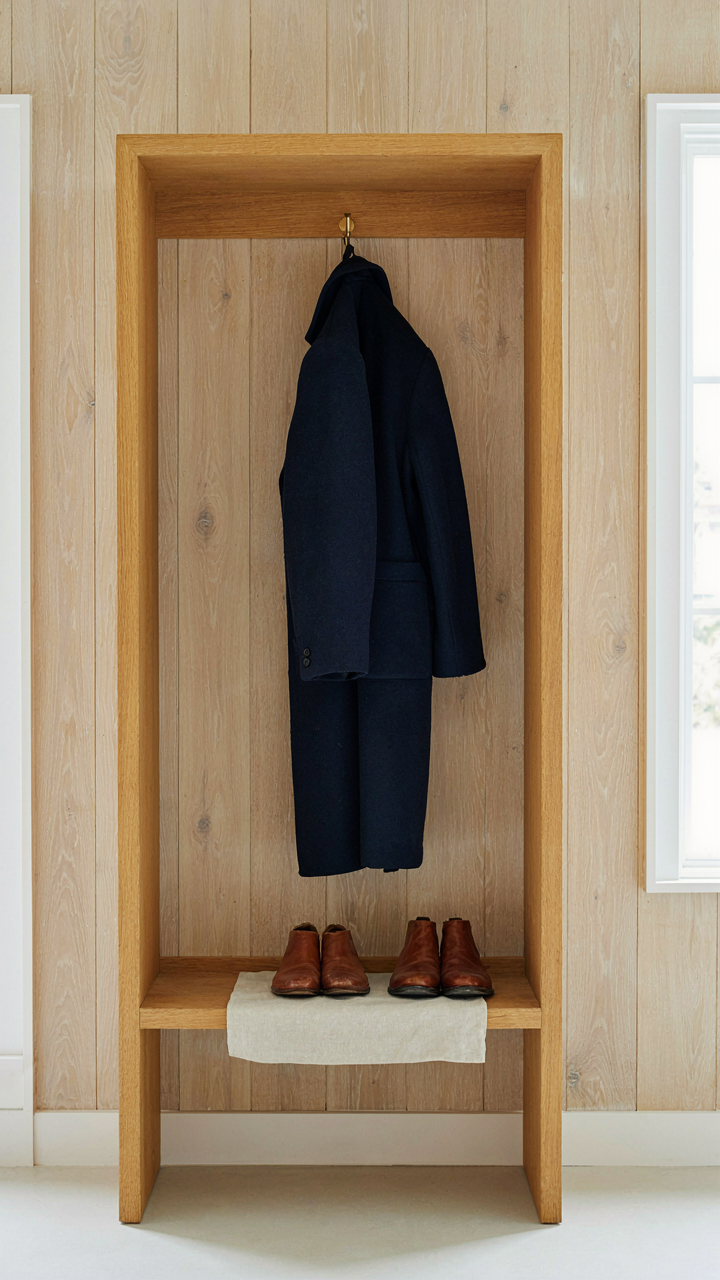
The Instagram Problem Masquerading As Design
You want people to see your mudroom and think you have your life together. That’s the real reason you’re here. The mechanism is simple: farmhouse aesthetics have become status signals, so families prioritize visual coherence over the actual problem their mudroom needs to solve. A shiplap-wrapped locker with vintage hinges looks intentional. It also doesn’t work for a family of five in winter.
The gap between beautiful and functional farmhouse mudroom lockers kills adoption. You buy the piece, hang it up, and six weeks later your kids are dumping coats on the floor again because the locker demands too much friction to use. Pretty doesn’t override behavior. The locker fails not because of the design itself, but because aesthetic decisions crowded out usability decisions before installation even happened.
Storage Abundance Creates Worse Clutter
This isn’t vague organizing folklore. This is basic economics: when supply exceeds friction, waste increases. Farmhouse mudroom lockers often get oversized to “give people room to grow,” but the inverse happens. More unused locker depth means coats get shoved deeper, boots accumulate in back corners, and visibility drops to zero. You lose track of what’s actually there.
The real play is constraint. Farmers understood this for centuries. A mudroom locker that holds exactly what gets worn this season forces decisions. You can’t hoard. You can’t ignore the backlog. Every item has to earn its space through actual use, or it moves out. Build your farmhouse mudroom lockers to match weekly rotation, not theoretical capacity, then watch the clutter problem solve itself.
The “Entryway Vortex” Protocol: Reclaim Your Boot Room

What Actually Stays Here
You care about this because chaos in the mudroom signals loss of control over your own home. The real mechanism at work is boundary collapse: without a clear definition of what belongs in this space, everything migrates here and nothing leaves. The mudroom becomes a holding pattern for decisions you haven’t made yet.

Start by naming what legitimately lives in a mudroom: seasonal outerwear, boots and shoes actively in rotation, items needed before leaving the house, and weather-specific gear. Everything else is trespassing. Your instinct to store off-season coats, old sports equipment, or “might need someday” tools here is budget friction masquerading as practicality. A farmhouse mudroom locker exists to serve the current season and the current household, not to be a catch-all for indecision. Strip it to function or watch it metastasize.
Deposit Or Disappear
One-touch rule means this: the moment an item enters the mudroom, it gets committed to one of three states—active use, seasonal storage with a date to leave, or removal from the house entirely. No items get to occupy limbo. This sounds obvious until you realize most families treat mudroom lockers like extended furniture where things rest between their last use and some never-defined future need.
When a boot, jacket, or bag crosses the threshold, it gets fifteen seconds of decision-making. Either it hangs in the locker because it’s worn this week or this month, it gets boxed and dated for removal after the season, or it walks out to donation or trash that day. The friction of not deciding is higher than the friction of deciding now. Build that into your system and the locker stays functional instead of becoming a archaeological site of abandoned gear.
Farmhouse Mudroom Design: Function Over Faux Charm

Build For Destruction, Not Instagram
You want your mudroom to look intentional and curated. That’s the real reason you’re reading this. Here’s what actually matters: farmhouse mudrooms fail because people choose materials that photograph well but crumble under daily use. Wood lockers absorb moisture from wet boots and coats. Untreated pine warps. Soft metals dent from backpacks slung against them. The mechanism is simple: high-traffic zones demand material resilience before aesthetics enter the room.

Pick materials that survive abuse without maintenance theater. Powder-coated steel locker frames outlast stained wood by years. Vinyl-coated hooks resist corrosion from wet gear. Closed-back lockers prevent wall damage from wet jackets pressed against drywall. Cement-based flooring takes mud and standing water without degrading. The material choice you make on day one determines whether you’re refinishing wood every eighteen months or ignoring the same locker for a decade.
The Geometry Of Movement
Traffic flow in a mudroom operates on the same principle as military supply lines: minimize distance between entry and storage, eliminate decision points that slow the user down. Most farmhouse mudroom designs waste space with decorative centering or symmetrical arrangements that force people to walk past empty hooks to reach their assigned locker. The real cost isn’t aesthetic, it’s friction.
Map your family’s actual entry pattern first. Kids drop gear at the closest point. Adults need a clear visual scan to find their section in under three seconds. Position lockers perpendicular to the main pathway, not facing it. Assign one locker per person at consistent heights, not spread across the wall. Remove any hook or shelf that doesn’t serve a specific function. The protocol: enter, locate locker, store gear, leave. No zigzagging. No hunting. No second trips.
Mudroom Lockers: The Unsung Hero Of Daily Transitions

Own Your Space
You want the chaos to stop. You want to know where things are without asking. That’s the real mechanism at work here. Dedicated zones turn the mudroom from a collision point into a sorting system. Each family member gets their own vertical real estate. Nothing shared. Nothing ambiguous. When everyone knows their locker is theirs alone, they stop abandoning coats on the bench.

The farmhouse aesthetic actually helps this work. Open cubbies with labeled baskets or hooks make ownership visible. A child sees their name carved or stenciled above their space and the behavior follows. It’s not motivation through punishment. It’s friction reduction through clarity. Assign space first. Then watch compliance happen naturally because the path of least resistance now leads to the right place.
Stack High, Leave Floor Clear
Physics teaches load distribution. In mudroom design, the principle is verticality: move weight and storage upward instead of spreading it across the floor. Farmhouse lockers that climb the wall instead of sprawl horizontally save the one resource every family actually competes for: floor space.
Wall-mounted lockers also force a hard constraint that prevents overflow. A four-foot-high stack of cubbies holds what it holds. Nothing more. The floor stays clear for boots and bags in motion. This is the opposite of what most families do, which is fill horizontal storage until it becomes invisible junk. High lockers make ownership and capacity both obvious and non-negotiable.
Deconstructing The Mudroom Remodel: Efficiency First
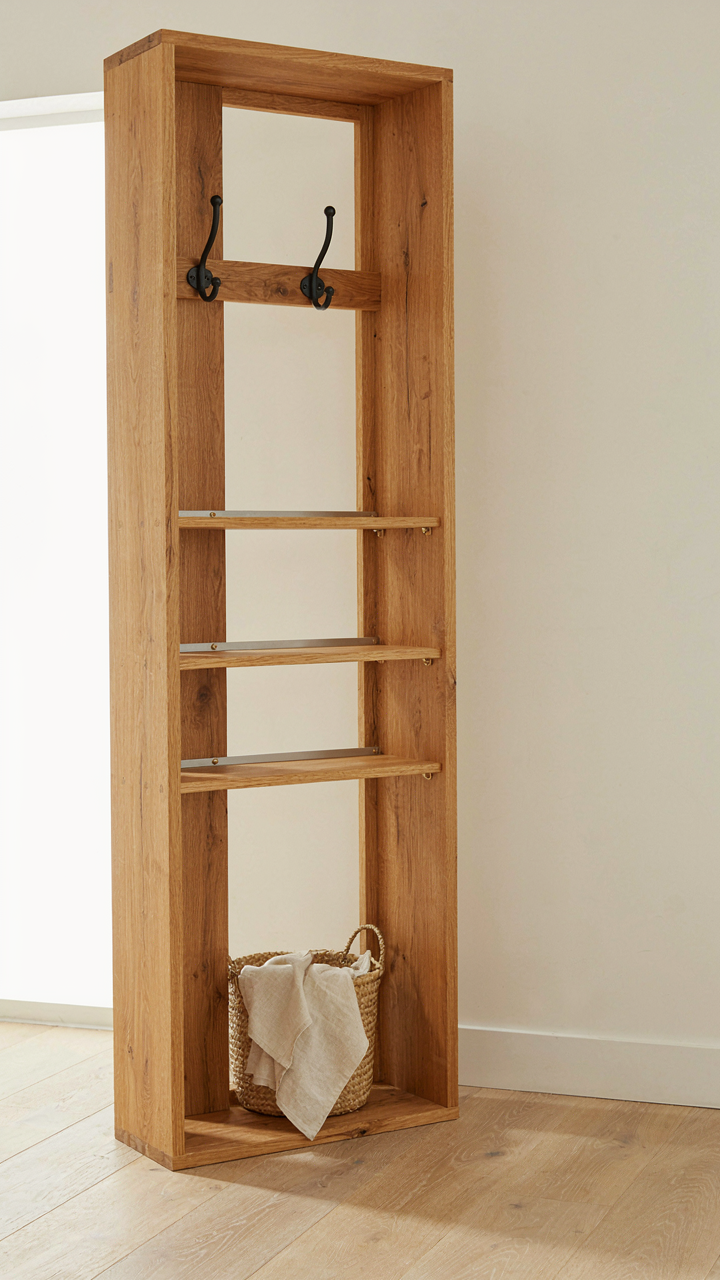
Buy Durability, Not Instagram
You want this to look intentional and polished because you’re tired of your mudroom looking like everyone else’s disaster zone. Here’s the mechanism: farmhouse mudroom lockers fail because families treat them as furniture when they’re actually infrastructure. Wood that handles seasonal humidity swings costs more upfront. Solid pine or reclaimed barn wood absorbs and releases moisture without warping. Particle board and MDF swell in spring, shrink in winter, crack by year three. The real cost isn’t the sticker price—it’s replacing garbage twice.

Durable hardware outlasts trends. Forged iron hinges and solid brass hooks don’t corrode from sweat, dirt, and salt spray. Cheap hardware oxidizes, sticks, and forces you into a second remodel within five years. Pick materials rated for mudroom conditions: high humidity, temperature swings, constant contact. A farmhouse locker built from quarter-sawn oak with mortise-and-tenon joinery operates the same way in year ten as year one. That’s not nostalgia. That’s engineering.
Scale The System Before Your Family Changes
Economics calls this the concept of carrying capacity. A mudroom locker system with fixed dimensions hits its limit the moment your needs shift. Your family grows, ages, or changes routines. Suddenly four hooks aren’t enough. A single shelf doesn’t accommodate sports gear. The locker you built for a toddler’s snowsuits now stores a teenager’s lacrosse equipment and your partner’s work boots.
Design vertical modularity into your locker layout from the start. Use adjustable shelving, removable dividers, and mount hooks on horizontal rails instead of fixed points. This lets you reconfigure zones without tearing into studs. A mudroom locker that adapts to three different family phases costs the same to build as one that requires replacement after phase one. Build the frame, not the fixed layout. Your locker should change when your family does—not the other way around.
The “Information Theory” Of Mudroom Cubbies
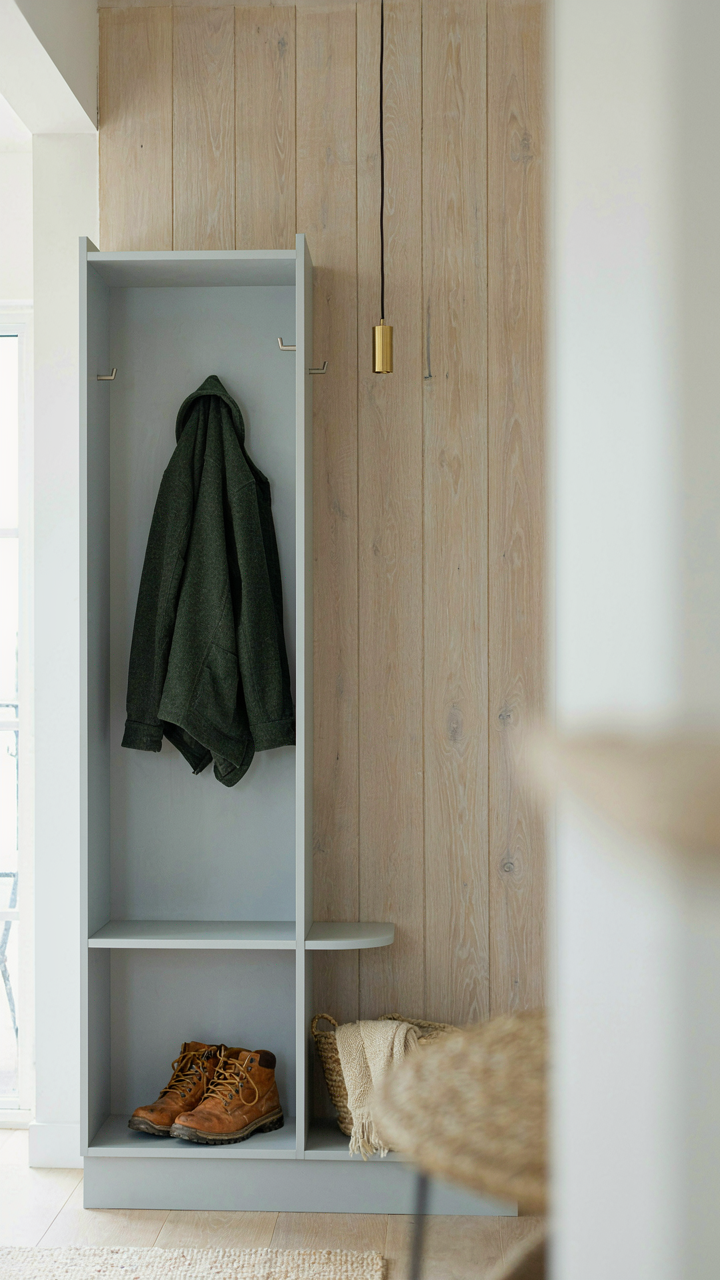
Noise Versus Signal In Your Locker Layout
You want your mudroom to look intentional because chaos reads as failure, and failure means you’re not handling your life. Here’s the mechanism: information theory teaches signal-to-noise ratio, which applies directly to locker design. Signal is what matters: boots, coats, backpacks. Noise is everything else cluttering the visual field. Each locker becomes a communication channel. When you cram random items into view, you destroy the ratio. The farmhouse aesthetic actually demands this clarity because the style originated from functional design, not decoration. Sparse, purposeful objects signal competence.

Your eyes need white space to process what’s actually there. Overcrowded lockers force your brain to work harder to find what you need, which means slower mornings and higher friction. Paint the interior of deep lockers a neutral tone. Use vertical dividers sparingly. Install one hook per person, not three. When every item has a location and nothing competes for attention, the entire system becomes faster and easier to maintain. Fewer decisions mean fewer failures.
What Each Locker Can Actually Hold
The real constraint isn’t the size of your locker, it’s cognitive load. Cognitive load is information theory’s channel capacity applied to human behavior: how much can a single container handle before the person using it stops following the system. Most farmhouse mudroom lockers fail because families treat them like catch-alls rather than bounded spaces with hard limits.
One person’s locker should hold: seasonal coat, current shoes, school bag, and one backup layer. That’s it. The moment you add “maybe these mittens” or “I’ll keep that here too,” you’ve exceeded capacity and the system breaks. Families with multiple children need individual lockers, not shared cubbies. When capacity is clear and personal, people maintain the discipline. Assign each child their own locker depth and width, then enforce the boundary ruthlessly. Everything else goes in storage elsewhere.
Lockers In Mudroom: Beyond Coats And Shoes
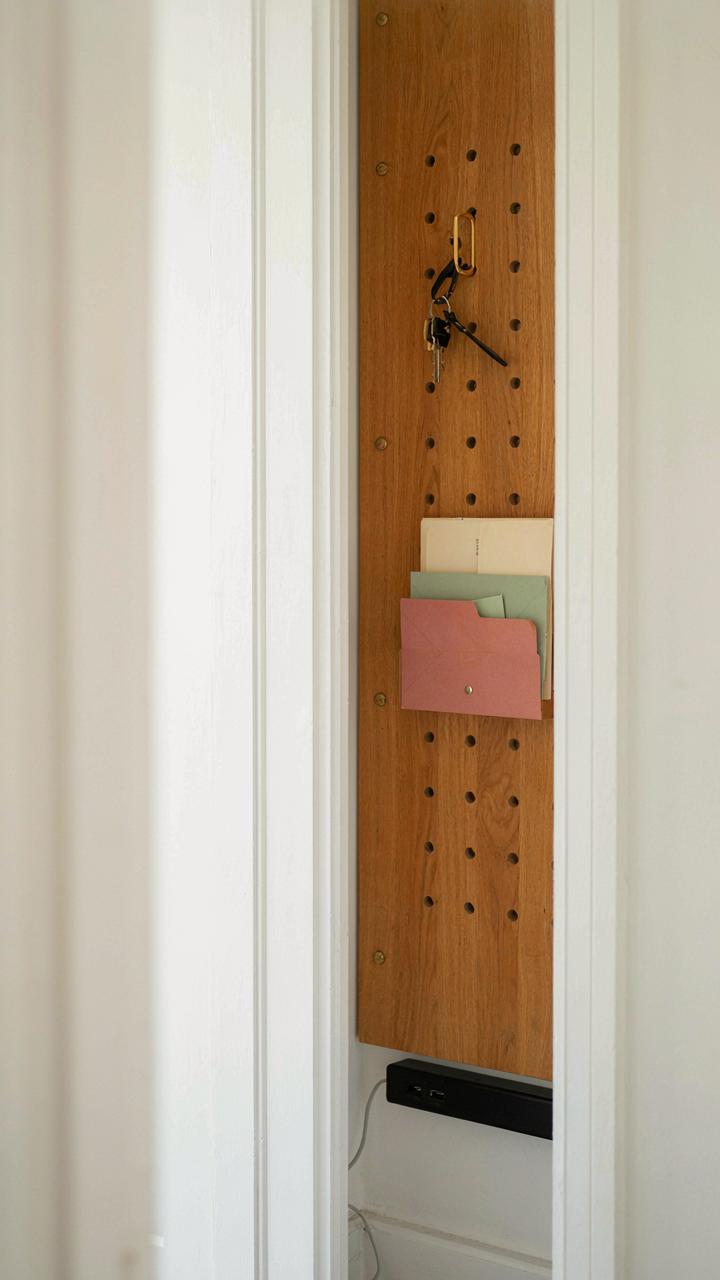
Dedicated Zones For Daily Friction Points
You want the mudroom to solve your family’s chaos problem without admitting you’ve lost control of it. The real mechanism is task stacking: every object that causes friction when you leave or enter the house needs its own zone, not just its own shelf. Keys, mail, and charging stations aren’t decoration. They’re friction reducers.

Install a narrow vertical locker section or pegboard insert specifically for keys and mail at adult eye level, near the door threshold. This placement matters because people check these items during the transition moment when they’re already stopping. Add a low-voltage charging station inside the locker frame itself—USB strips mount to the interior side panel. Phones, tablets, and smartwatches dock here before they scatter across counters upstairs.
Managing Seasonal Weight And Clutter Creep
Inventory rotation isn’t a cute organizational tip. It’s a constraint from supply chain management: you can only efficiently store what you’re actively using. Families treat mudroom lockers like attics and watch them calcify with off-season gear that never leaves.
- Winter coats and boots: Store in individual locker sections September through March. Use vacuum bags for deep storage behind the active zone to reclaim vertical space.
- Spring and summer gear: Rotate sports equipment, garden tools, and light jackets into the front-facing locker sections when temperature shifts. Archive heavy items in labeled bins elsewhere.
- Sports rotation: Keep current season equipment accessible. Hockey, soccer, and baseball gear cycles through different lockers as seasons change, preventing permanent clutter.
- Outgrown children’s items: As kids grow, their coat and shoe sizes shift rapidly. Designate a temporary “transition locker” for items in flux before donating or storing off-site.
- Moisture management: Seasonal rotation prevents mildew buildup in damp climates. Remove items for the season, clean the locker interior, and allow it to dry fully before restocking.
Set a hard rule: if something hasn’t been worn in six weeks, it exits the mudroom locker into storage elsewhere. This creates space pressure that forces decision-making instead of letting sentimental items occupy prime real estate indefinitely.
The “Entrée Maison” Illusion: Your Home Starts Here

Systemized Entry, Not Just Pretty
You want people to think you have your life together the moment they walk through that door. Here’s the mechanism: a farmhouse mudroom locker functions as a threshold device—it signals order before chaos enters the home. Psychology borrowed this from architecture: the vestibule doesn’t just separate spaces, it separates states. Your mudroom locker does the same work. Coats, boots, bags, and permission slips stop at a defined boundary. They don’t migrate to the kitchen counter.

Most people treat mudroom storage as decoration first and system second. That’s backward. The real work happens when you assign each family member a vertical zone—upper shelf, middle shelf, lower peg. Not based on aesthetics but on what gets grabbed in a five-second morning rush. A seven-year-old’s zone should hold only what a seven-year-old needs to grab. The locker enforces this constraint before your brain has to. That’s the mechanism: physical limitation replaces willpower.
Mental Reset Before Entering Home
The transition from outside to inside is not sentimental, it’s neurological. You’re stepping from one operational context into another. A farmhouse mudroom locker marks that threshold deliberately. The moment you place something into your assigned slot, you’ve completed the entry ritual. This small act of placement tells your nervous system: you’ve arrived. You can now be present in the home instead of still carrying the outside world with you.
Generic mudroom advice says: keep it minimal and light colored. Accurate advice says: make the locker functional first, and the placement itself must require intentional action. If grabbing your coat takes two seconds, you haven’t performed the reset. If it takes eight seconds because you must open a door and locate your section, you’ve shifted mental gears. Don’t underestimate this mechanism—the friction is the feature.
Why Your Mudroom Entryway Needs Less, Not More

Decluttering As Friction Reduction
You want people to think you have your life together. The mechanism that actually makes this happen isn’t more storage—it’s fewer decisions. Borrowed from systems engineering, “friction” is the resistance between intention and action. A farmhouse mudroom locker with eight compartments per person creates friction. Each item demands a choice. Each choice drains cognitive load. Your family stops using the system because the system requires too much thinking.

The common advice tells you to “organize better” or “label everything.” Wrong angle. Reduce the volume first. Fewer jackets mean fewer decisions about which jacket goes where. Fewer shoes mean the locker stays usable without daily maintenance. A mudroom that demands constant curation fails within weeks. A mudroom with 30 percent of the capacity it could hold works for years because it runs on autopilot.
Empty Space Functions Like Infrastructure
Most people see empty locker space as wasted real estate. It’s not. Empty space is the infrastructure that prevents the system from collapsing. When a farmhouse mudroom locker is perpetually at 70 percent capacity, you lose the ability to grab a coat and leave. You fumble. You knock things over. You stop using it.
Design the mudroom with deliberate gaps. One section stays empty. One shelf holds nothing. This isn’t minimalism as aesthetic—it’s buffer space as operational requirement. When kids rush through before school, they jam coats in fast. When someone needs the damp jacket immediately, they find it without excavation. The empty space makes the system survive contact with real family life.
The 80/20 Rule For Farmhouse Mudroom Success
Find The Real Culprits
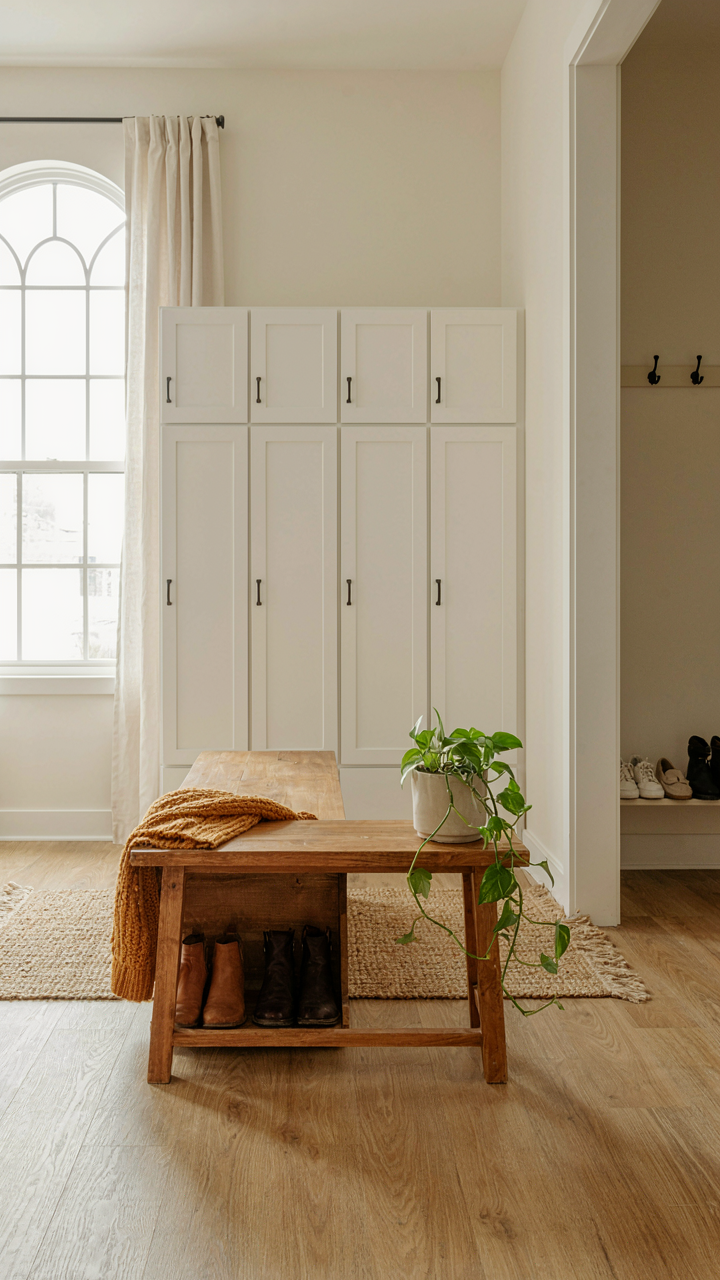
You want your mudroom to look intentional instead of like a holding pen for your family’s chaos. The Pareto Principle from economics applies here: twenty percent of items create eighty percent of your clutter problem. Most families don’t identify this twenty percent because they blame the locker system instead of what’s actually moving through it. The mechanism is simple. Track what lands on the floor or gets shoved into corners for two weeks. That’s your answer.
Boots cause more friction than anything else in a farmhouse mudroom. Seasonal clothing piles up faster than you rotate it. Bags, backpacks, and sports gear multiply without a clear home. You’ll notice school supplies and outdoor tools claiming shelf space no one allocated to them. Once you name these five to eight items, you’ve found your actual problem. Everything else is just noise filling the remaining space.
Route The Problem Away
Generic advice tells you to buy more storage. Wrong. You don’t need bigger lockers. You need these items to stop entering the mudroom in the first place. Boots go directly to a boot tray outside the exterior door before they reach your locker system. Seasonal gear lives in a closed cabinet in the garage or basement instead of rotating through active storage. Sports equipment gets assigned a dedicated bin on a separate rack, not inside family lockers where it displaces daily necessities.
The protocol is direct: map where each high-impact item currently lands, then create a barrier one step before it reaches your locker. Install a mudroom bench with under-seat storage for boots. Mount a wall-mounted shoe rack outside the mudroom entrance. Assign a rolling cart for sports gear that sits perpendicular to the locker bank. This removes the decision-making burden from every family member and stops the real clutter source at the entry point.
The Real Obstacle Isn’t Your Mudroom; It’s Your Assumption That More Stuff Solves Less Time
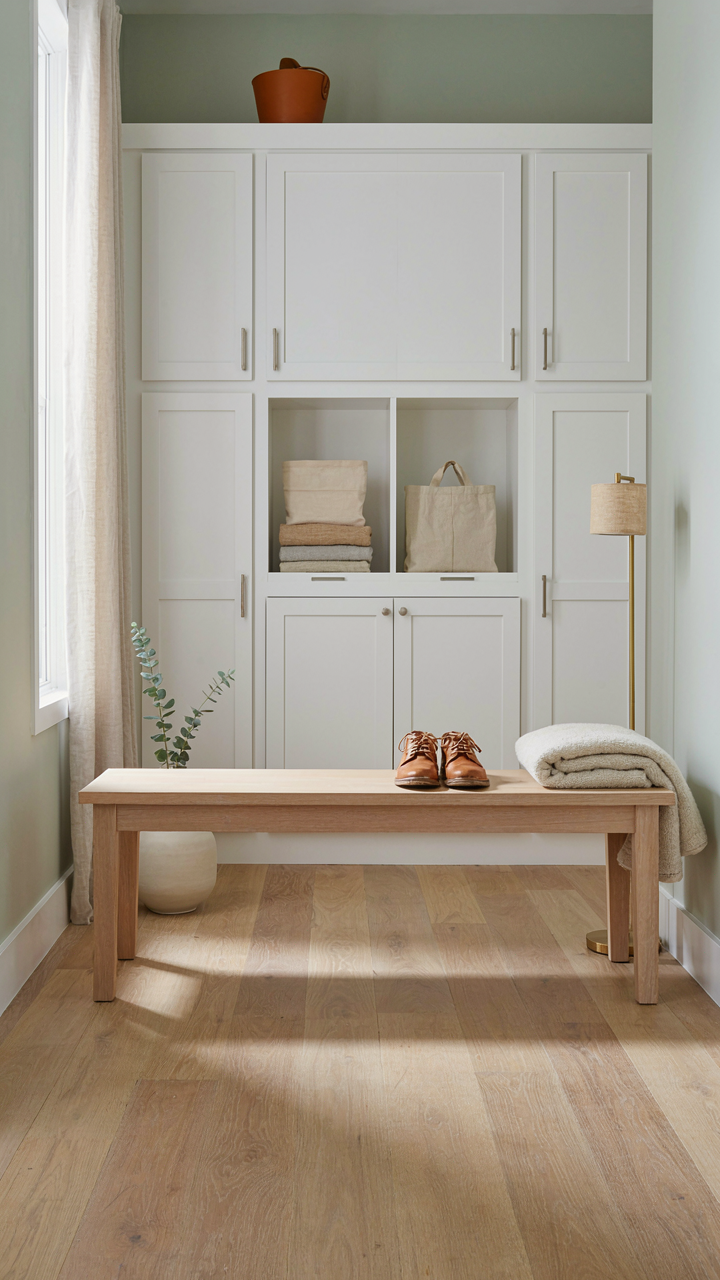
Your farmhouse mudroom lockers won’t fix chaos. They expose it. Before you buy another organizer, ask yourself what actually needs storing versus what you’re just moving around. The families who win don’t own prettier lockers. They own fewer things. Pick one shelf in your mudroom today and remove everything that doesn’t earn its spot. Your future self won’t thank you for the lockers you installed; they’ll thank you for the decisions you made.