

The Illusion Of Comfort: Why Your Window Sitting Design Fails

Aesthetics Over Anatomy
You want the window seat to look like it belongs in a magazine because you think that means it’ll feel good to sit in. It won’t. The gap between Instagram cottage aesthetics and actual human biomechanics is where most window seats fail before anyone ever uses them. A seat that photographs well often violates basic spine alignment. The depth, angle, and back support get sacrificed for visual symmetry. You end up with something that looks intentional but punishes your lower back after twenty minutes.
Furniture design borrowed its best principles from ergonomics, not decoration. Ergonomics treats the body as a system with specific requirements: lumbar curve, hip angle, arm reach. A cottage window seat ignores these inputs and prioritizes silhouette instead. The standard mistake is making the seat too deep relative to the backrest distance. This forces your legs to extend or your spine to round forward. Add throw pillows on top of a fundamentally broken structure and you’ve just hidden the problem, not solved it.
Real Support Starts With Frame
The pillow stack is a band-aid on structural failure. What actually determines comfort is what sits underneath. The seat frame needs a backrest at 100 to 110 degrees from horizontal, not vertical. This angle prevents your spine from bearing all your weight. Most cottage window seats have vertical or near-vertical backs because they look cleaner. They create tension in your shoulders and neck within the first hour. The seat depth should measure 16 to 18 inches from backrest to front edge, matching standard chair proportions. Anything deeper forces you to choose between losing back support or letting your legs dangle.
The base structure determines everything else. Use a hardwood frame with proper joinery, not particleboard with dowels. The seat platform itself needs either a plywood base with upholstered foam or quality spring suspension. Cheap foam compresses within months and creates a valley. Measure your window opening and design the frame to fit snugly, then build backward from ergonomic requirements rather than forward from dimensions.
The Unseen Value: Bench Below Window As A Productivity Hub

From Daydreaming To Deep Work
You want permission to sit and stare without feeling lazy. That’s the real reason you’re reading this. A window seat works because it solves a neurological problem, not an aesthetic one. Your brain cycles between focused attention and diffuse mode—the unfocused state where connections form. A bench positioned below a window gives you a legitimate anchor point for both states without guilt.

Psychologists call this “environmental scaffolding.” A cottage window seat acts as a spatial cue that signals your nervous system: this location means sustained thinking is happening here. The view itself becomes a safety valve. When your prefrontal cortex fatigues from directed work, your eyes move to the landscape outside, and your mind processes what you’ve learned. You’re not distracted. You’re cycling intentionally. The bench keeps you seated long enough for this cycle to complete.
Lighting, Power, And Surface Demands
Everyone says “put it by a window for natural light.” That’s incomplete advice because it ignores the actual work you’ll do there. A cottage window seat becomes useless if you can’t execute your specific task. Natural light alone doesn’t solve for seasonal variance, time of day, or task type. You need a layered approach.
Position the bench to receive north-facing light if possible—it’s consistent and shadow-free across hours. Install a swing-arm sconce or recessed fixture above the seat for winter mornings and evening work. Add a small side table with at least eighteen inches of depth for your laptop, notebook, or craft materials. Run power to the table base through the wall during renovation, or use a slim raceway along the baseboard if you’re retrofitting. The mechanism is simple: remove friction between intention and execution. If reaching for your phone requires stepping away from the window seat, you stay focused. If your device needs charging, you won’t.
The Scarcity Principle: Maximizing Small Window Benches

Hidden Storage Changes The Math
You want a window seat that looks serene and uncluttered because you believe empty space signals wealth and taste. It doesn’t. The mechanism is simple: constraint forces design. A small window bench has one job—to function in fifteen square feet or less. That’s economics terminology: scarcity creates value.

Build storage into the bench structure itself, not around it. Lift the cushion to access a hinged compartment underneath. Run drawers along the base. Use the space beneath the seat to store blankets, books, or seasonal items. This eliminates the need for separate furniture and keeps the visual line clean. The bench becomes its own solution instead of a problem that demands more stuff nearby.
Walls Work Better Than Floors
Most people waste the real estate above the bench. They hang a single painting or leave it bare. That’s backwards. Your window seat sits in a corner where wall space runs vertical and stays unused. Treat the wall like an extension of the furniture itself, not decoration added after.
Install floating shelves 18 to 24 inches above the seat back. Mount them at eye level when seated so you reach without standing. Stack books spine-out. Place a small lamp on one shelf for reading light positioned to avoid window glare. The wall transforms into functional storage that reinforces the bench’s purpose without eating floor space. Each shelf lifts items off tables and clears the zone around your seat.
The “Observatory” Protocol: Curating Your Home Reading Area

Where You Sit Determines What You See
You want this to feel intentional, like you chose something rare. The real mechanism is borrowed from military strategy: sightlines. A vantage point controls information flow. Your cottage window seat works the same way. Where you position yourself determines which visual field enters your mind during reading breaks. Most people plop a chair anywhere and call it done. That’s why their reading corners feel like accidents, not refuges. The best window seats sit at an angle to the room, not centered. This gives you dual awareness: the page in front, the world outside, without competing for the same visual lane.

The physics of attention matters here. Your eyes naturally track movement and contrast. Placing your seat where you catch peripheral activity from the room’s entrance keeps you from feeling isolated or vulnerable. Simultaneously, the window behind or beside your line of sight lets external motion (trees, weather, light changes) register without demanding focus. This dual-axis setup reduces cognitive load. Your brain stops scanning for threats and settles into reading. The cottage window seat becomes functional because it answers a primal need: you can see without being trapped.
Harvest Light Like It’s A Finite Resource
Light isn’t decorative. It’s the operational foundation of a reading area that actually works. Most advice says “pick a sunny spot.” That’s incomplete. You need to understand light dynamics across the day. Morning light in a cottage window comes at a shallow angle, perfect for reading without glare on paper. By noon, direct light creates harsh contrast that forces your pupils to adjust constantly, killing focus. Late afternoon light is warm but weak in winter months. The mechanism is simple: position your seat where morning or early afternoon light hits the reading surface at forty-five to sixty degrees. This angle illuminates the page without casting your shadow across it or creating screen glare if you use a device.
Artificial augmentation fills the gaps without apology. A brass or matte black reading lamp mounted to the window frame or wall beside the seat provides consistent task lighting when natural light fails. This isn’t optional in cottages, which typically have smaller windows and interior walls that block light early. Combine directional artificial light with a pale wall finish behind your seat. The wall acts as a reflector, bouncing both natural and artificial light back onto your reading surface. Test the setup during your weakest daylight hours. If you can read small print without eye strain or adjusting position, the light harvest is sufficient.
Beyond The Bench: Window Library Ideas As Cognitive Anchors
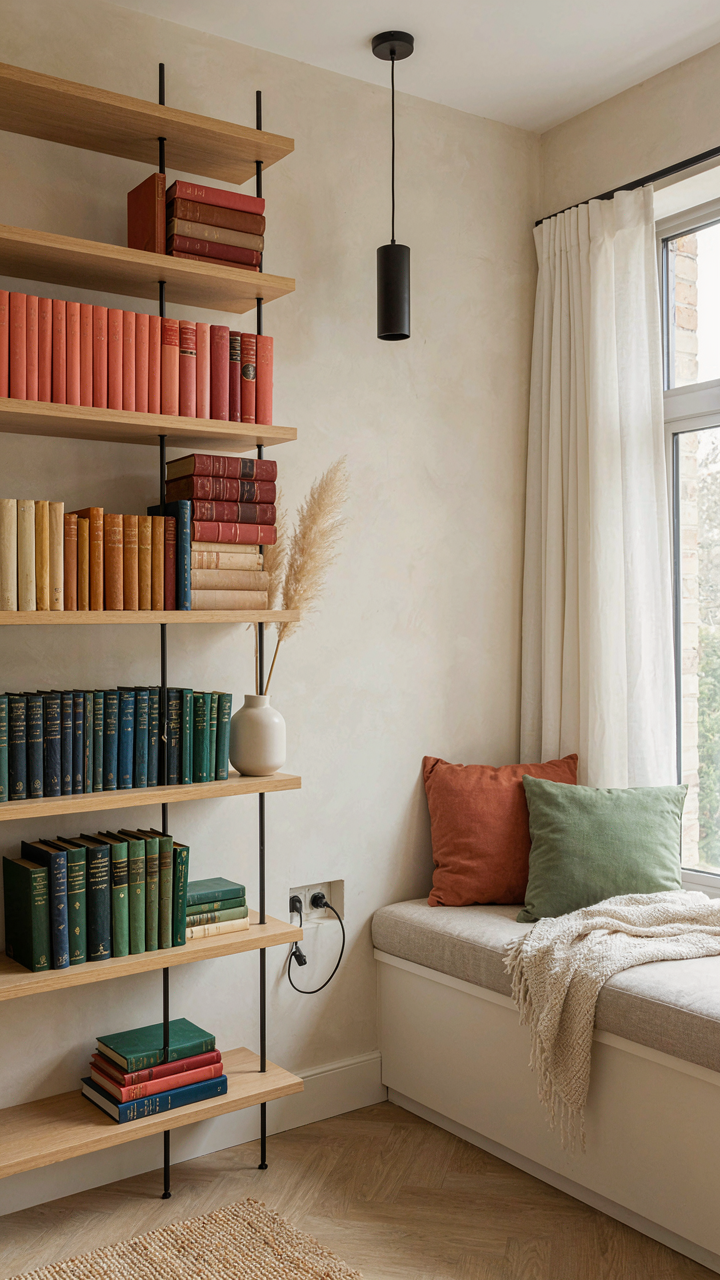
How To Organize Books For Actual Access
You want your window seat to look curated. That’s the real reason you’re reading this section. But a beautiful unread library is just expensive decoration. The mechanism that matters is friction: every book you can’t quickly locate becomes invisible to your brain, which means you stop reaching for it.

Organize by frequency of use, not by aesthetic category. Keep your current reads within arm’s reach. Stack or shelve books you return to monthly in the middle zone. Reserve the high shelves for reference material you consult once a year. This mirrors how your attention actually works, not how design magazines say libraries should look. One shelf curated beats ten shelves ignored.
Charging Stations Without The Clutter
Digital integration ruins most window seats because people treat it as an afterthought. Run power before you commit to furniture placement. A single outlet behind the seat means cables stretched across the floor. Install recessed charging during renovation if possible. If that’s not an option, route power through a low-profile conduit along the baseboard to a discreet location near the seat frame itself.
The pivot isn’t adding gadgets to your window seat. It’s hiding the infrastructure so the space feels intentional instead of temporary. A tablet holder mounted to the frame edge works only if the charging cable disappears into the wall or runs through the furniture’s interior. Tablets and e-readers near books create real friction reduction: you can switch formats mid-thought without leaving the seat.
The “Biomimicry” Method: Engineering Serenity By Window Ideas

How Natural Systems Engineer Comfort
You want this to feel effortless, like you stumbled into the perfect spot rather than designed it. That desire for authenticity is precisely why most window seats fail—people treat them as decoration instead of functional ecosystems. Ecology teaches us that thriving systems don’t fight their environment; they work within constraints. A cottage window seat is a microecosystem. It must regulate temperature, filter incoming stimuli, and create psychological safety through redundancy.

Nature doesn’t overstimulate. A forest floor has layered coverage that blocks wind and excess light. Your window seat needs the same architecture. Multiple fabric layers, a depth of at least 18 inches, and strategic placement relative to direct sun accomplish what trees do through canopy structure. The mechanism is simple: you’re removing choices for the nervous system, not adding comfort items. When a space makes fewer demands on attention, the brain allocates resources elsewhere.
Temperature, Noise, And Tactile Response
The mistake people make is treating thermal comfort as a single variable. It isn’t. Physics defines thermal comfort as a balance between convective, radiative, and conductive heat transfer. In a cottage window seat, you’re managing all three simultaneously. Direct sunlight creates radiant heat that feels different than ambient room temperature. A thermal mass like stone or dense wood beneath the seat absorbs this heat and releases it gradually, stabilizing the microclimate rather than spiking it.
Sound control requires the same specificity. Cottage window seats near exterior walls catch exterior noise, wind resonance, and thermal expansion sounds in the frame itself. Thick upholstery handles mid-range frequencies, but you also need mass behind it. Dense batting, combined with a solid backing rather than open framing, stops low-frequency rumble that your brain registers as irritation even if you don’t consciously hear it. The tactile layer—what your skin contacts—should feel substantive without being cold. Natural fibers like linen or wool regulate moisture and temperature without the plastic feel of synthetic materials.
The “Leverage” Framework: Bench Seat Bookshelf As Force Multiplier

How Physics Reveals Your Real Problem
You want a window seat that doesn’t waste square footage. That’s the real fear hiding under all the design talk. In physics, leverage means moving a heavy load with minimal effort by using a fulcrum and a long beam. A bench seat with built-in bookshelves operates on the same principle: one footprint, multiple functions. The fulcrum is the bench itself. The load is storage, seating, and display. You’re not adding rooms. You’re multiplying what one corner already does.

Most cottage design advice treats a window seat and storage as separate problems you solve sequentially. Wrong. A bench seat with integrated shelving doesn’t add complexity. It reduces it. The structure carries both the weight of sitting and the weight of objects. Install backing and shelves into the bench cavity during construction, not after. This avoids the mechanical failure that happens when you bolt shelves to drywall above a seating surface where people shift their weight.
Cubic Efficiency Beats Square Footage
The real metric isn’t how much wall space you use. It’s cubic capacity per pound of material. A standard cottage window seat bench occupies roughly 4 to 6 linear feet of wall and sits 18 inches deep. Without shelving, you’re using a 3D object for one purpose. With vertical shelving built into the sides and back, you’ve transformed dead air into usable volume.
Measure your window nook’s width, depth, and the height from bench seat to ceiling. Divide that vertical space into 12-inch intervals. Each interval becomes a shelf. A 5-foot-wide nook with 48 inches of wall height above the bench gives you four shelf layers of 60 cubic feet combined storage capacity. Use the bench cavity itself for off-season items or large books that won’t fit upright. Stack utility into layers, not outward.
The “Antifragile” Design: Window Seat Design Living Rooms
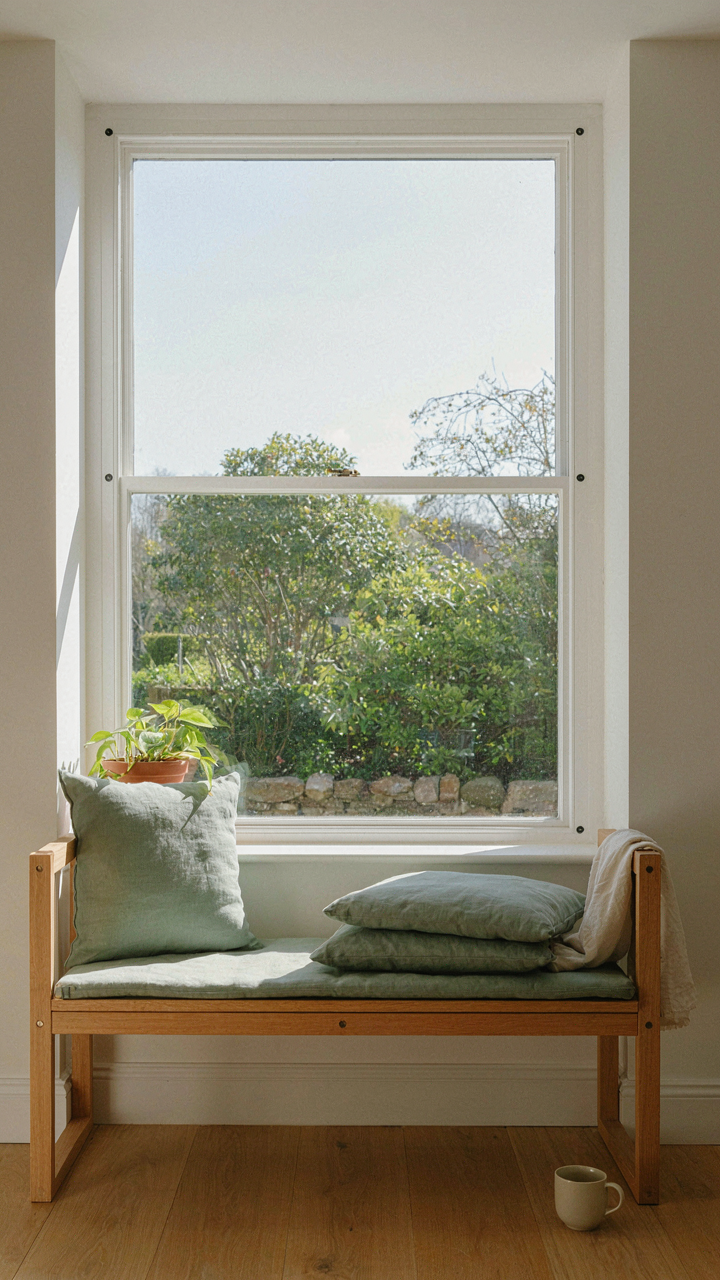
Modularity That Survives Your Changing Life
You want a window seat that won’t look dated or force a full redesign when your needs shift. The mechanism is simple: build in reconfigurable layers instead of one fixed solution. A cottage window seat built as a system beats one designed as a statement piece. Think of it like Unix architecture in software, where small independent components stack without forced dependencies. Your seat cushion, storage base, and backrest should function independently, not as a welded unit.

This means using bolt-together frames instead of built-ins glued to the wall. A modular base lets you swap cushion depths when you move from reading to sleeping to working at a small desk. Removable backrests adjust height without structural changes. Drawers slide out and reorganize without dismantling the whole structure. The cottage aesthetic survives because the wood frame stays; only the function adapts.
Materials That Outlast Your Attention Span
Cheap advice tells you to pick materials that “feel cozy.” Wrong. Pick materials that degrade predictably and repair cleanly. Wear is information. A cotton slipcover yellows evenly and washes without falling apart. Solid wood frames check for rot in visible places, unlike particle board that hides failure until collapse. Stone window ledges don’t need refinishing; they just patina. Linen cushion covers fade uniformly rather than staining in blotches.
- Solid hardwood frames (oak, beech, pine): Accept seasonal movement without warping catastrophically, making repairs straightforward when needed.
- Natural fiber slipcovers (linen, canvas, wool): Age visibly and launder without synthetic breakdown, replacing sections individually if worn.
- Stone or solid wood sills: Require minimal maintenance and show wear patterns that guide maintenance timing rather than hide damage.
- Metal joinery (bolts, brackets): Remains functional indefinitely, allowing frame rebuilds or reconfiguration without replacing entire structure.
- Horsehair or wool batting: Compresses gradually and remains resilient longer than foam, outlasting multiple cover replacements.
Build your cottage window seat expecting to replace the soft goods every five to eight years while the frame lasts thirty. This is the real durability calculation: not avoiding maintenance, but choosing materials where maintenance is cheap, visible, and doesn’t spiral into full replacement.
The Unspoken Cost: Avoiding Common Cottage Window Nook Pitfalls

Material Choices That Rot Your Budget
You want to believe the Instagram version will age gracefully. It won’t, and that’s the real mechanism here: soft materials in high-moisture zones fail fast, then you’re replacing everything at three times the original cost. Cottage windows collect condensation. Water pools on sills. Fabric absorbs it. Wood swells. Cheap cushioning deteriorates within two seasons.

Use marine-grade plywood for structural elements, not standard lumber. Outdoor-rated upholstery fabric handles moisture without degrading. Teak or cedar for any exposed wood resists rot naturally. The material choice determines whether your nook becomes a money pit or a decades-long investment. Evaluate material longevity against your local humidity and seasonal temperature swings before you buy anything.
Following Trends Into Irrelevance
Most cottage window seat advice recycles whatever dominated design media last year. Minimalism, maximalism, coastal, cottagecore, mid-century revival. The trap is borrowing from marketing instead of function, a concept called “planned obsolescence” from industrial economics. You build something that looks dated the moment the trend shifts.
Functionality doesn’t trend. A deep seat with proper back support works now and in ten years. Neutral upholstery in durable fabric outlasts color palettes. Storage solutions solve actual problems regardless of the aesthetic moment. Build for how you’ll use the space daily, not for how it photographs today. Your nook should age into character, not out of relevance.
The Real Obstacle Isn’t The Seat; It’s Your Inability To Define True Value

Most people build a cottage window seat to fill empty space. They want the Instagram moment, not the actual stillness. The shift happens when you stop treating it as furniture and start treating it as non-negotiable time. Your next action is simple: sit in that corner for fifteen minutes today without your phone. Just sit. What you notice in that silence tells you everything about what you actually need from the space. A cottage window seat isn’t a purchase decision; it’s a declaration that your solitude matters more than your productivity.



