The Authenticity Illusion: Why Your “Farmhouse” Feels Fake

Manufactured Charm Versus Genuine Patina
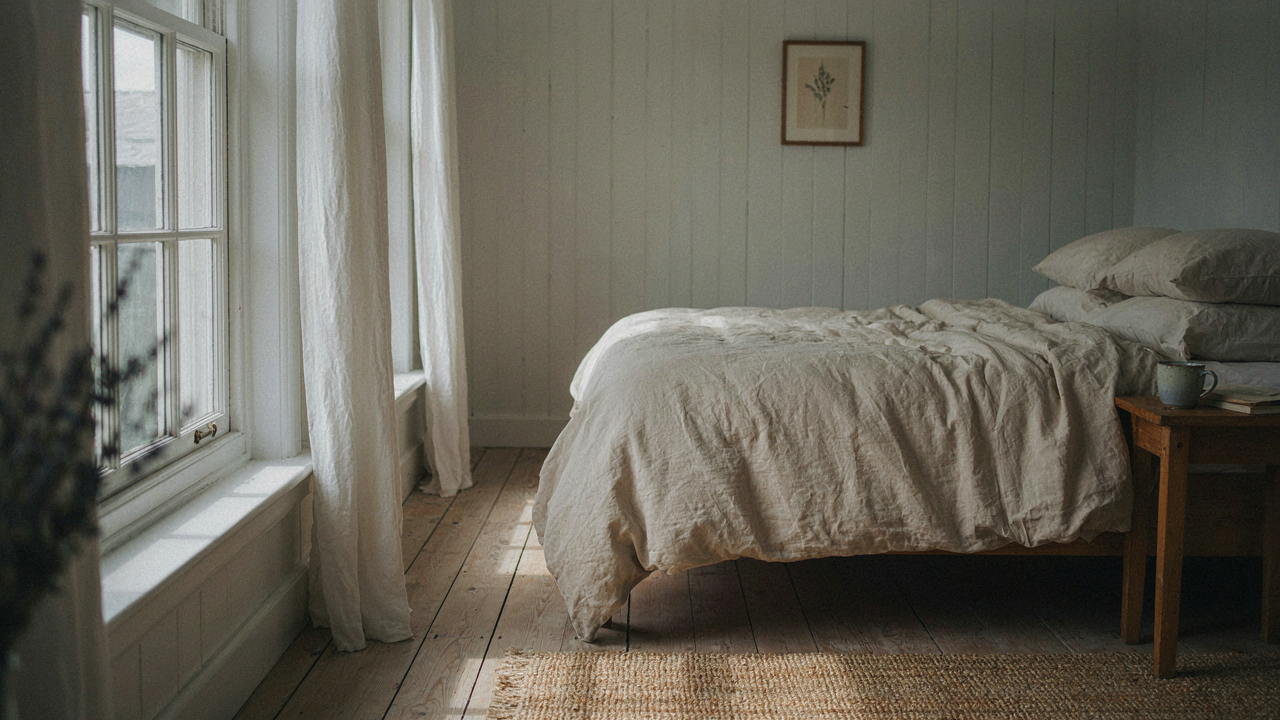
You want people to believe your bedroom has history without actually waiting for it to develop. That’s the real tension here. The mechanism is signal decay: mass production flattens specificity. When ten million people buy the same distressed wood nightstand from the same factory, nobody reads it as authenticity anymore. They read it as a costume.
Genuine patina comes from use and time. A real farmhouse bedroom has wear patterns that match the room’s function. Scratches near drawer handles. Fading on surfaces that catch morning light through actual windows. Color variation from decades of temperature and humidity shifts. Factory distressing mimics the visual output but skips the causality. Your brain knows the difference, even if you don’t articulate it.
Design Shortcuts That Signal Artifice
The advice to “layer textures and neutrals” is incomplete because it doesn’t address the core problem: coherence. Your bedroom feels fake when each piece comes from a different aesthetic tribe. A Restoration Hardware bed frame, a Wayfair rug, an Etsy macramé wall hanging, and a Target throw pillow don’t unite into farmhouse. They unite into indecision.
Real farmhouse bedrooms have material constraint built in. Farmers didn’t order from five different retailers. They used what was available regionally, what lasted, what got repaired in place. Start by choosing one material family and one era. If you’re building around reclaimed wood, commit to actual reclaimed sources or barn wood suppliers, not new wood stained to look old. If you’re referencing 1950s rural American bedrooms, source from that decade’s manufacturers. Constraint breeds coherence.
Beyond Shiplap: Deconstructing The Modern Farmhouse Bedroom Formula
The Psychology Of Oversaturated Whitewash
You want the farmhouse bedroom because you think it signals restraint and taste, but all-white rooms actually signal the opposite: fear of commitment. The mechanism is saturation. When every surface matches, your brain stops processing the room as a space and starts processing it as a void. Whitewash became the farmhouse default not because it’s sophisticated, but because it’s safe. It requires no decision-making after the first one.

Historical farmhouses used white lime wash for practical reasons: it reflected heat, it was cheap, it covered rough walls. Modern farmhouse copied the aesthetic without the context, which created a dead zone instead of a functional space. A bedroom that feels empty doesn’t feel restful, it feels incomplete. The whitewash trend persisted because design magazines needed a neutral canvas to photograph furniture, not because it solves any actual human need for morning comfort or visual rest.
When Depth Requires Breaking The Neutral Rule
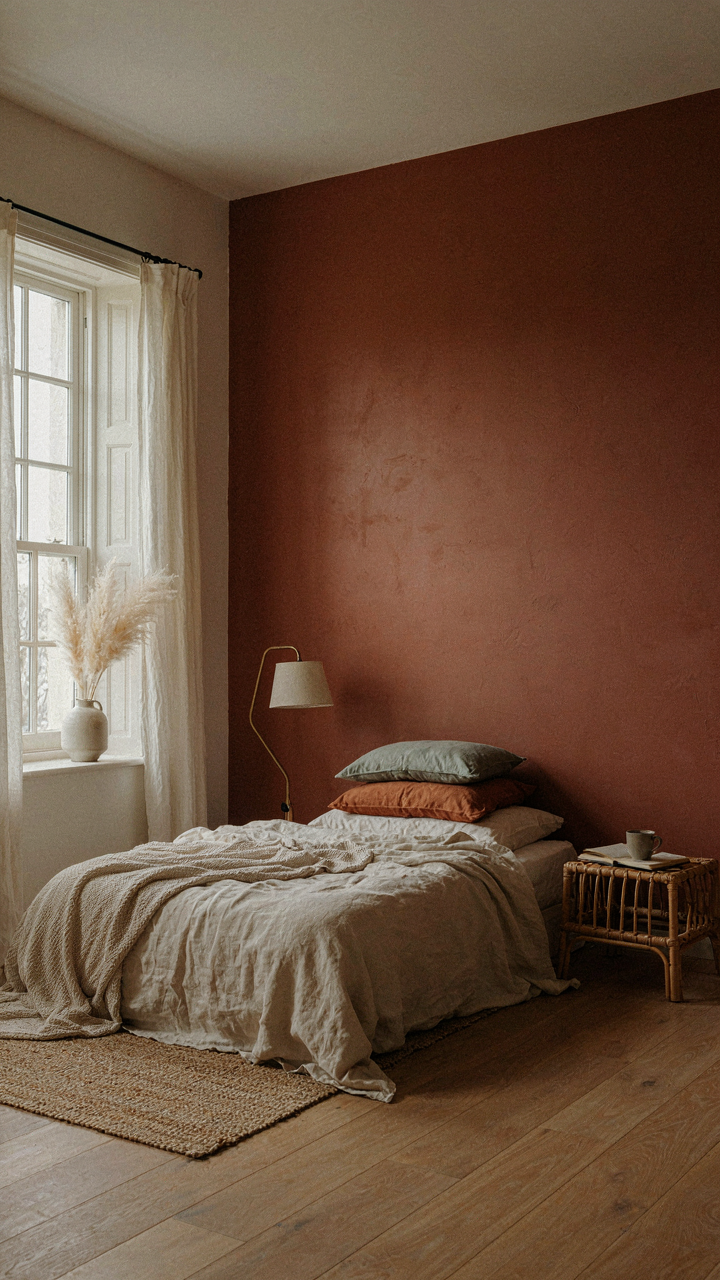
The common advice is wrong: farmhouse bedrooms don’t need to stay neutral to feel cohesive. They need contrast to feel grounded. Depth in farmhouse spaces comes from texture variance and one accent color that echoes the room’s working history. A soft sage or muted charcoal wall paired with cream trim creates visual hierarchy without chaos. This is where most people fail, they add color then panic and dilute it until nothing registers.
The mechanism is cognitive load. Your eye needs an anchor point in the room. Without it, the space feels flat even if it has seven different textures. Pick one wall or feature that holds a slightly darker or warmer tone than the baseline, then let everything else support it. A bedroom with one intentional depth choice signals design clarity and costs nothing extra. Start with your focal wall, typically the one you see first from the doorway, and commit to a tone that’s at least three shades deeper than your baseline.
The “Rooted Resilience” Method For Dreamy Farmhouse Interiors

Everything Works Together Or Nothing Does
You want farmhouse bedroom ideas because you’re tired of spaces that feel fragmented and temporary. The real mechanism here is ecological interconnectedness: in biology, an ecosystem fails when one organism loses function because everything depends on everything else. Your bedroom works the same way. A reclaimed wood nightstand only lands if the flooring, walls, and lighting all reinforce the same material language. Pick one element in isolation and it screams “I’m trying.” Coordinate the system and it becomes invisible.

Most people start by buying a statement piece—a vintage bed frame or an old barn door headboard—then wonder why the room feels off. They treat farmhouse design like decoration instead of architecture. The real work is backward: decide what materials and finishes will repeat throughout the space, then let every choice filter through that lens. Wood tone, metal finish, textile weight, wall texture. These aren’t details. They’re the connective tissue that makes a room feel coherent instead of curated.
Natural Selection Favors What Lasts
The common advice is to buy “farmhouse” branded furniture and call it done. That’s wrong. Farmhouse design isn’t an aesthetic—it’s a methodology for choosing things that survive use. Farmers didn’t design barns to look good. They built them to function for decades with minimal maintenance, which created a visual language as a side effect.
Apply this filter: Does this piece improve with age or does it deteriorate visibly? Solid wood ages. Particle board reveals itself. Metal hardware oxidizes in a way that reads as character, not damage. Linen and cotton fabrics fade evenly. Synthetic blends pill and stain unevenly. Real farmhouse bedroom choices prioritize durability over newness because they expect the room to be lived in, not photographed. When you select materials based on longevity instead of trend, you stop replacing things every two years. That’s the actual mechanism. Buy things built to last, and you’ll naturally end up with a room that looks intentional after a decade.
Unearthing Character: Vintage Finds Vs. Modern Farmhouse Reproductions

The Real Cost Of Authenticity
You want authentic pieces because you believe they signal taste to people who visit your bedroom, and you’re terrified a reproduction will expose you as a fraud. Here’s the mechanism: economics punishes genuine antiques through scarcity pricing, while reproductions exploit that fear by mimicking patina at scale. A real 1920s dresser costs three times what a distressed new one costs because supply is fixed. The reproduction maker buys machines that sand and stain wood to look aged, then scales that production infinitely. Genuine antiques appreciate slowly or stay flat. New farmhouse reproductions depreciate immediately but deliver the visual outcome faster and cheaper. The trade-off is simple: authenticity costs capital upfront, reproductions cost credibility later when someone who knows furniture walks past your bed.

Authentic pieces carry invisible costs beyond the price tag. Structural repairs compound silently—loose joints, refinished surfaces that need maintenance, hardware that requires sourcing or replacement. Reproductions arrive finished and stable. If your goal is a functional, visually coherent bedroom this month, buying one authentic anchor piece and filling gaps with intentional reproductions beats the inverse. If your goal is a collection that tightens in value and tells a coherent historical story, source selectively from auctions and estate sales, then stop shopping. Most people split the difference poorly by mixing price points without strategy.
Finding Real Pieces With History Attached
The hunting ground matters more than the hunt itself. Most bedroom farmhouse pieces come from three channels: estate auctions, local antique cooperatives, and online marketplaces with verifiable seller histories. Estate auctions give you provenance and the ability to inspect before bidding. Cooperatives let you negotiate directly and inspect physical condition. Online sources require ruthless vetting of seller feedback and return policies because photos lie about wood tone, patina, and structural soundness.
- Estate auctions and liquidation sales: Local funeral homes and auction houses often list bedroom furniture from homes being settled. You get photographs, lot descriptions, and the chance to preview physically before bidding. Prices run fair because competition is real.
- Antique malls and cooperatives: Independent dealers rent booth space and price their own items. You negotiate directly, skip the buyer’s premium, and inspect condition immediately. Dealers often know the piece’s origin and repair history.
- Craigslist and Facebook Marketplace: Private sellers often price lower than dealers but provide zero guarantees. Verify construction methods, wood species, and hardware against period standards before committing. Arrange inspection in daylight.
- Salvage yards and architectural reclamation: Specialized vendors stock recovered pieces from demolished homes. You find genuine hardware, doors, and built-in elements. Prices reflect rarity and condition variability.
- Specialized online auction platforms: Sites with authentication standards and seller ratings reduce fraud risk. Shipping costs are steep, but return policies are structured. Use these when local options exhaust.
The real differentiator is developing a baseline for wood construction, hardware, and finish methods from whatever era you’re targeting. Learn to identify hand-forged nails, machine-cut dovetails, and period-appropriate stains before you bid. Once you know what authentic looks like structurally, you stop overpaying for reproductions marketed as salvage, and you stop missing deals on pieces that need basic restoration.
Tactile Truths: Crafting Comfort In Your Farm Style Bedroom

Natural Fibers Over Everything Else
You want your bedroom to feel authentic because you believe it will make you feel more authentic. Here’s the mechanism: texture signals safety to your nervous system before your brain processes anything visual. Farmhouse design borrowed from textile engineering the concept of “hand feel”—how fabric behaves against skin. Linen, wool, and cotton dominate farmhouse bedrooms not for nostalgia but because they have variable surface profiles that engage tactile receptors. Synthetic fibers feel uniform and dead by comparison.

The common advice tells you to “mix textures for visual interest.” Wrong angle. Prioritize materials that perform—linen wrinkles and softens with use, wool regulates temperature without trapping moisture, cotton breathes and ages visibly. These aren’t decorative choices. They’re functional substrates that improve with time and use, which is why they appear in farmhouse spaces. Your sheets, blankets, and pillow covers should be the opposite of trendy. Buy them as tools, not décor.
Layering For Sensory Depth, Not Display
Farmhouse bedrooms fail when people layer for photographs instead of for the body. You need distinct sensory feedback at each level of contact: sheet texture differs from blanket texture, which differs from throw texture. A typical setup stacks a fitted sheet (crisp linen), a flat sheet (softer cotton), a wool blanket (weight and warmth), and a textured throw (visual break, different hand feel). Each layer serves a mechanical purpose—moisture management, insulation, weight distribution, temperature adjustment.
The trap is over-layering to look “cozy.” Four functional layers accomplish more than seven decorative ones. When you add a layer, ask what problem it solves: Does it add weight? Regulate temperature? Change how your skin experiences the bed? If the answer is “it looks nice,” remove it. Your morning comfort comes from predictable sensory input, not visual abundance. Rotate your throw weekly so you’re not pressing your face against the same textile every night.
Illumination Strategy: Lighting Your Farmhouse Bedroom Ideas For Mood, Not Instagram
The Overhead Light Trap
You want the room to feel effortless, but you’re afraid dimly lit spaces read as depressing. Here’s what actually happens: a single overhead fixture trains your brain to treat the bedroom like a garage. The mechanism is circadian biology. Your eyes expect directional light sources at different times of day, not uniform ceiling wash. Overhead-only lighting flattens depth, kills texture, and makes farmhouse materials—rough wood, linen, plaster—disappear into shadow. The real problem isn’t darkness. It’s monotony.

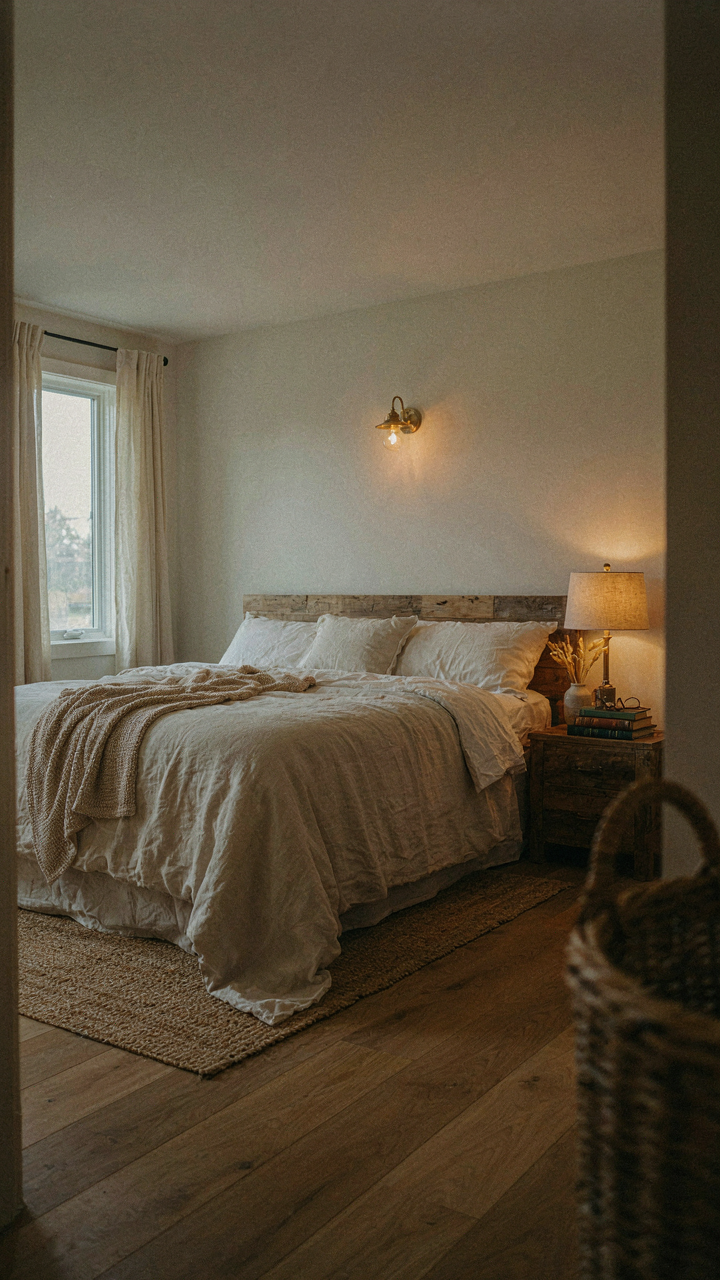
Layered lighting isn’t trendy advice. It’s how human vision interprets space. Use a ceiling fixture for general brightness when you need it, but build your actual environment around bedside sources, wall sconces, or task lights positioned at eye level or below. A farmhouse bedroom with three independent light sources feels inhabited and calm. One overhead light makes it feel temporary. Install your sconces 36 to 40 inches above the nightstand surface so the light pools without glare, and keep the fixture brass or blackened iron—materials that don’t compete visually with aged wood frames.
Creating Pockets Of Light
Zones aren’t about aesthetics. They’re about behavioral anchoring. Applied to a bedroom, this means different light intensity for dressing, reading, and sleep preparation. A 60-watt equivalent bulb at the dresser keeps tasks visible without overstimulation. The same bulb near the bed forces your eyes to work too hard at night. Instead, place a small table lamp on each nightstand with 40-watt equivalent bulbs in warm color temperature, roughly 2700K. This anchors your nervous system to the bed itself, not the room.
Install a dimmer on your ceiling fixture and any wall sconces. Dimmers give you control without adding fixtures or complexity. Start your wind-down routine at 50 percent brightness two hours before sleep—your bedroom then becomes a place that physically supports rest instead of asking you to enforce it mentally. The shift is subtle until it isn’t. After two weeks, stepping into a properly lit farmhouse bedroom will feel like stepping into permission to relax.
The Unseen Layer: Cultivating A Cozy Country Morning Atmosphere

Scent And Sound Shape Your Wakefulness
You want a farmhouse bedroom to feel special because you’re tired of generic spaces that do nothing for your nervous system. Here’s the mechanism: your brain processes scent and sound before it processes visuals. You can’t think your way into relaxation, but olfactory and acoustic input bypass your conscious mind entirely and reset your baseline state.

Farmhouse bedrooms historically relied on these non-visual layers because electricity was limited. Open windows carried morning bird calls and grass smell. Linen storage released subtle lavender or cedar notes. Recreate this by positioning your bed near a window that faces trees or open land, and introduce one specific scent anchor: dried lavender in a sachet, cedar from real wood furniture, or beeswax candles lit during your morning routine. Sound follows the same logic. A mechanical alarm trains your nervous system to spike cortisol. Replace it with a window positioned to catch natural bird activity, or a low-volume nature recording playing thirty minutes before you wake.
Removing What Disrupts Your Actual Rest
The standard advice says to remove clutter and add neutral colors. That’s incomplete. Real distraction isn’t visual noise alone—it’s decision fatigue and environmental stimuli that keep your nervous system partially activated. Neuroscience calls this sustained attention load. In a farmhouse bedroom context, this means eliminating objects that trigger task-switching: visible work materials, phone chargers placed where you can see them during idle morning moments, or decorative items demanding constant visual assessment.
Start with the nightstand. One lamp. One water glass. Nothing else. Remove the dresser from your direct line of sight when lying in bed—reposition it perpendicular to your sightline or behind a wooden screen. Close all drawers fully. Keep bedroom doors to closets shut. The mechanism is simple: your eyes land on an object, your brain instantly catalogs whether it needs attention, and that micro-activation compounds across dozens of morning moments. Eliminate the objects, and you eliminate the activation cycles.
Function Over Form: The Practicality Of A True Farmhouse Bedroom
When Aesthetics Stop Working
You want this room to look intentional because you’re afraid it’ll look cheap or accidental instead. Here’s the mechanism: farmhouse design works only when every object has a reason to exist beyond decoration. A working farmhouse bedroom prioritizes use over appearance. That means surfaces clear for function, furniture placed for movement, and materials that tolerate daily wear without apology.

The aesthetic fails the moment form dominates utility. Woven baskets stacked for visual interest but never opened. A ladder leaning against the wall because Pinterest said so, not because anyone climbs it. A farmhouse bedroom that photographs well but frustrates you to live in defeats its own purpose. Strip away the performance. Build for how you actually move through the space.
Honest Storage That Holds Weight
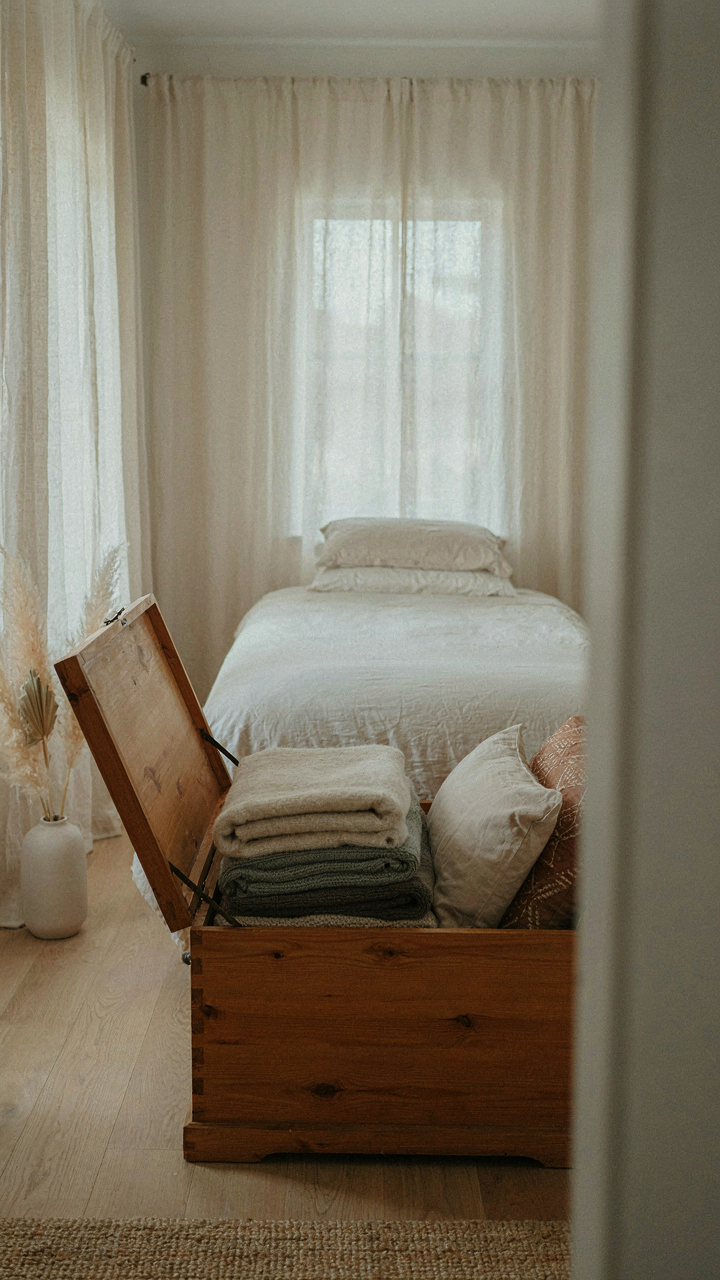
Storage advice typically suggests pretty containers and hidden systems, which wastes money on things you won’t maintain. Use economics language: you need maximum throughput at minimum friction. This means accessible storage that doesn’t punish you for using it. Open shelving on one wall beats a beautiful closet system you avoid because it takes too long to access. Drawers beneath the bed hold seasonal items without visual clutter. A wooden dresser with deep drawers tolerates years of use, unlike shallow novelty pieces that break under actual load.
The tactical move is matching storage type to retrieval frequency. Daily clothes hang or sit in open drawers at arm height. Off-season bedding and extra pillows live in under-bed containers or wall-mounted shelves. Everything else goes to the attic or another room. This eliminates the friction that makes you leave things on the floor, which destroys the entire aesthetic anyway. Assess what you actually store, then place it where you’ll actually access it.
The Real Problem Isn’t Your Decor; It’s Your Desire For Instant Tranquility
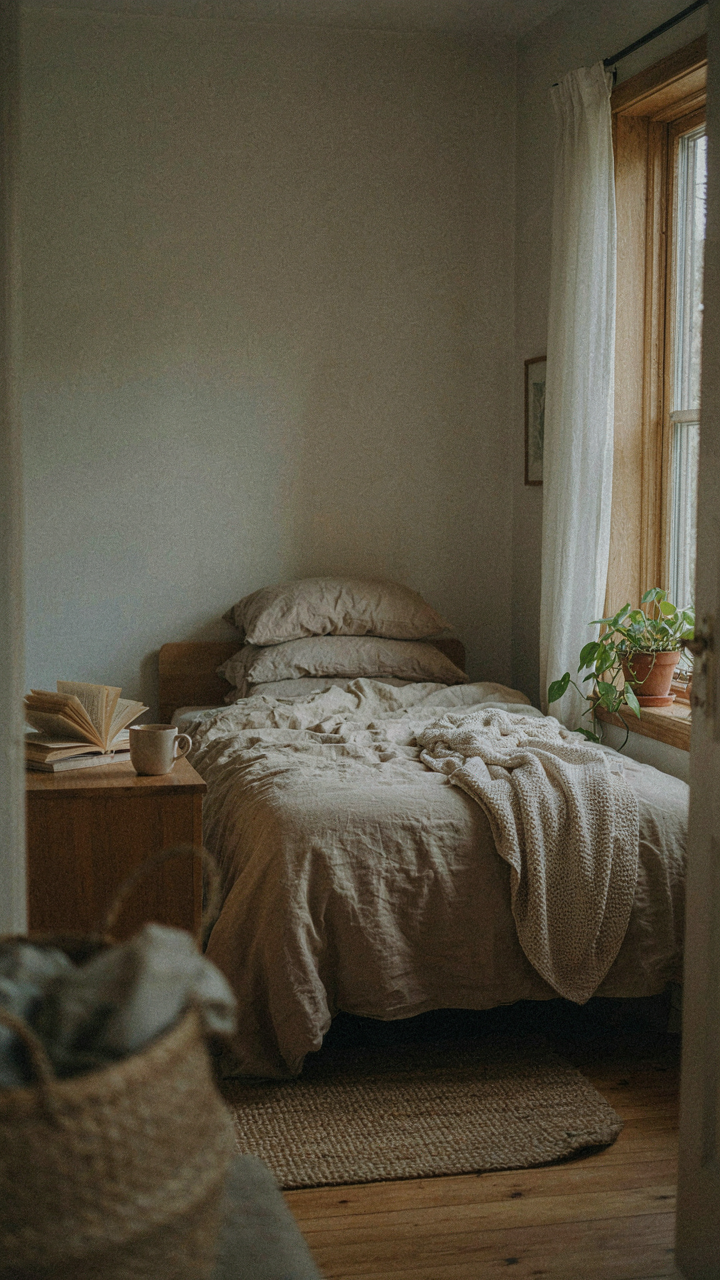
You don’t need another shiplap accent wall. You need to stop treating your bedroom like a problem Pinterest solves and start treating it like a space you actually use. Pick one element today—a linen duvet, a wooden nightstand, reclaimed beams—and commit. The coziness isn’t hiding in the catalog. It’s built through deliberate choices you live with, not scrolled past. Your bedroom works when you stop performing comfort and start demanding it.