
The Illusion Of Effortless Coastal Staircase Charm

What Coastal Actually Means
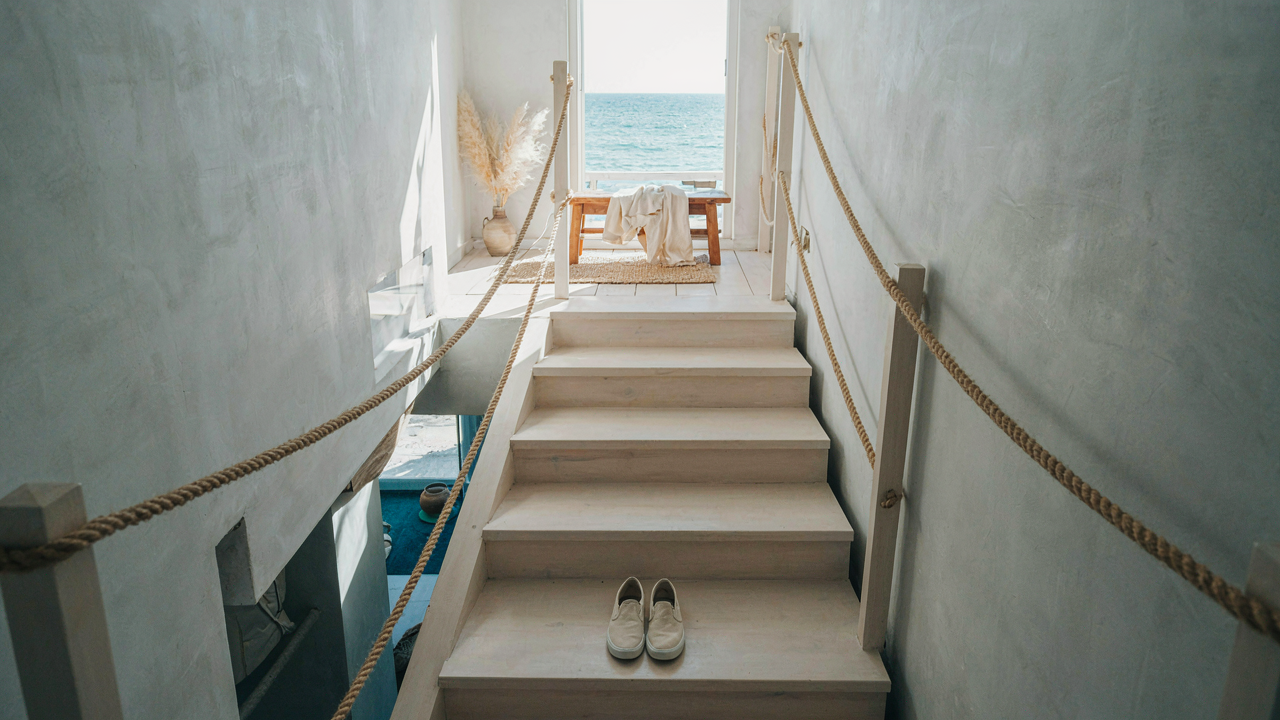
You want people to believe your staircase was built by someone who understands restraint and material honesty, not someone following a checklist. The mechanism is borrowed from industrial design: constraint breeds clarity. A coastal staircase works because it removes ornament, not because it adds rope and paint. Real coastal homes evolved their aesthetics from necessity—salt spray deteriorates finishes, so locals used durable materials and simple forms. Painted treads and rope rails became standard because they lasted, not because they photographed well.
Most design advice inverts this. It teaches addition when the actual principle is subtraction. You don’t “add coastal charm.” You eliminate what doesn’t serve the material reality of a salt-air environment. A staircase that looks effortlessly coastal is one where every element justifies itself functionally first, aesthetically second. That order matters. Rope worn by hand traffic tells a story. Paint applied to protect wood against moisture is visible. Neither element exists for decoration.
The Cost Of Aesthetic Imitation
Treating a coastal staircase as a theme demands aesthetic theatre, and theatre demands constant maintenance to stay believable. Rope that’s purely decorative frays without purpose. Paint applied for appearance alone chips and fails faster than paint applied to weatherproof. You end up replacing elements every two to three years instead of every decade because the original materials weren’t chosen for their actual environment, just their visual association with coasts.
The real mechanism is material compatibility. Wooden treads in a humid environment need paint or oil that resists moisture penetration. Rope rails need to be the weight-bearing kind—twisted natural fiber or synthetic, not ornamental cord. Start by auditing your actual climate conditions: humidity levels, salt spray distance, seasonal temperature swings. Then specify materials that survive those conditions without looking staged. This approach costs less over time and never requires the exhausting work of maintaining an aesthetic fiction.
Coastal Staircase: The Poverty Line Protocol
When Function Forced Design
You want this aesthetic because it signals restraint and authenticity, not because you actually understand why coastal cottages were built this way. Here’s the mechanism: coastal communities didn’t have access to timber mills or fabrication shops. They built with what washed ashore, what they could cut locally, and what their hands could manage. Constraint created the visual language. The painted treads and rope rails aren’t design choices. They’re solutions to salt air rot and the need for grip on wood that absorbed moisture constantly.

Economics teaches us about scarcity driving innovation. Apply this to stairs: limited materials force specificity. Coastal builders couldn’t order custom wrought iron or hardwood species from inland suppliers. They worked with softwoods, salvaged hardware, and rope from fishing operations. This constraint is what makes the aesthetic readable and reproducible. Your staircase either respects this logic or it doesn’t. Fake coastal design ignores the material poverty that created the look in the first place.
Salvage Materials Have Structural Rules
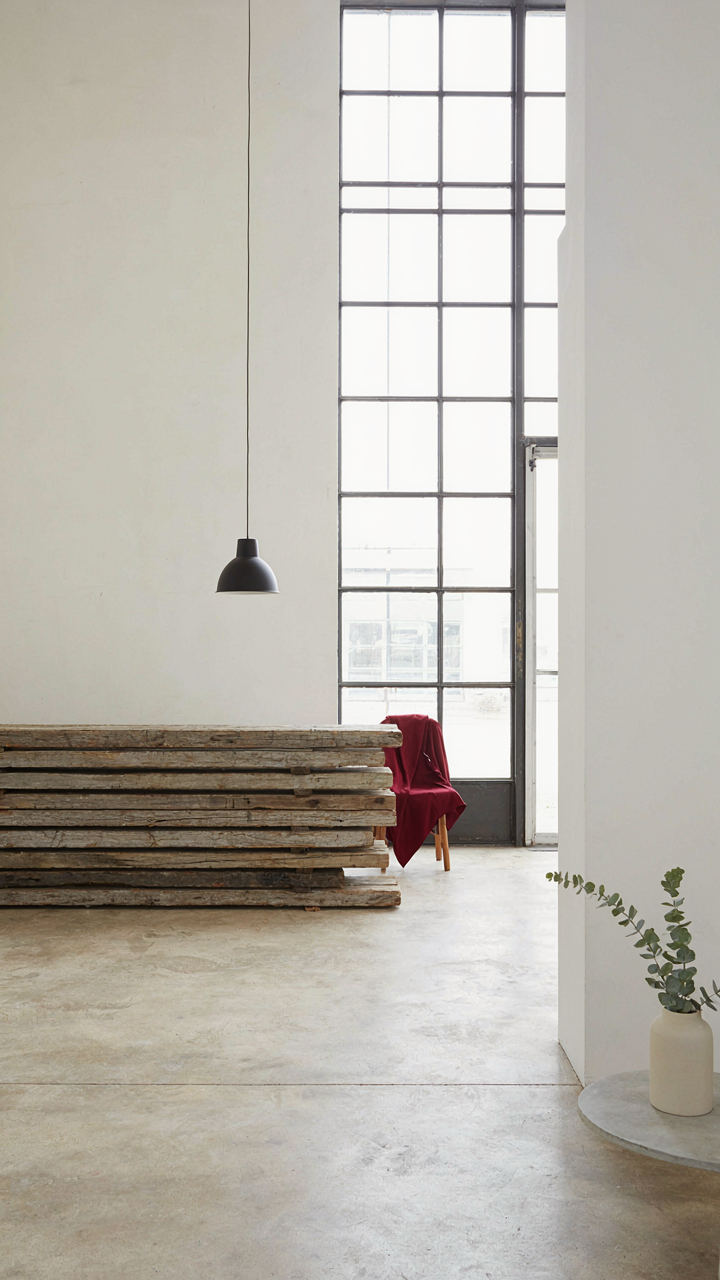
Most advice on salvaged materials is incomplete—it treats reclaimed wood like decorative trim when it’s actually load-bearing structure. Your treads carry weight. Your rails stop falls. Salvaged materials work in coastal cottages because they were originally selected for durability under specific conditions, not pulled from Pinterest. A weathered beam that survived forty years of salt spray has known performance data written into its grain.
Source salvage with specifications, not sentiment. Reclaimed dock wood, old pier pilings, and deconstructed barns provide treads that already handle moisture cycling. Rope rails work because they’re flexible under load and deteriorate predictably—you can inspect them and replace them. Match your salvage to its original purpose. Flooring salvage becomes treads. Structural salvage becomes support. Decorative salvage becomes wainscoting. The cottage aesthetic survives only when function dictates material choice.
Painted Treads: A Masterclass In Material Deception
Why Paint Matters Before Aesthetics
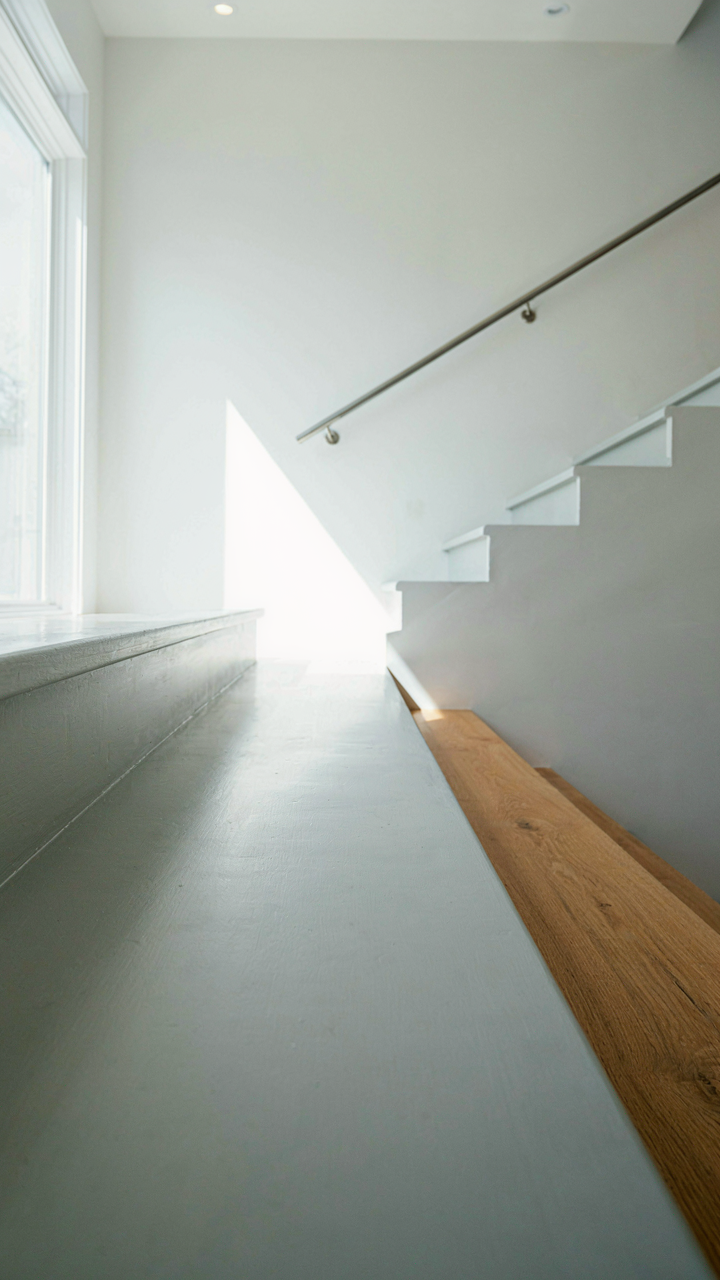
You want painted treads because you’re afraid cheap wood will betray you the moment someone’s foot hits it. The real mechanism is this: paint doesn’t just hide inferior material, it creates a protective barrier that extends the functional life of softwood by decades. Coastal environments demand this. Salt air corrodes exposed grain, moisture swells unfinished wood, and foot traffic splinters raw pine within months. Paint seals the surface against all three threats simultaneously.

The contradiction most people miss is that painted treads on budget wood outperform bare hardwood in coastal settings. Premium oak exposed to salt spray will cup and crack faster than primed pine. Paint becomes the load-bearing system, not decoration. This is why coastal cottage builders historically painted rather than stained, and why restoration specialists now reverse the trend only when the original finish proves structurally compromised.
How Color Reshapes Space Without Moving Walls
Optical science here: lighter tread colors have higher reflectance values, bouncing ambient and artificial light back into the stairwell to increase perceived luminosity. A narrow coastal cottage staircase painted in cream or soft white treads creates the illusion of width that architectural changes cannot achieve. This isn’t about prettiness. It’s about defeating the physics of confined space.
Darker treads compress a staircase visually, making cramped passages feel more claustrophobic. Conversely, light treads paired with white risers elongate sightlines vertically, making low-ceiling staircases breathable. Paint your treads in off-white or pale gray and you’ve purchased square footage you didn’t actually renovate. The color choice determines whether your cottage feels open or coffin-like before anyone steps foot inside.
Rope Rails: Form Follows Imperfect Function
When Installation Fails, Everything Else Fails
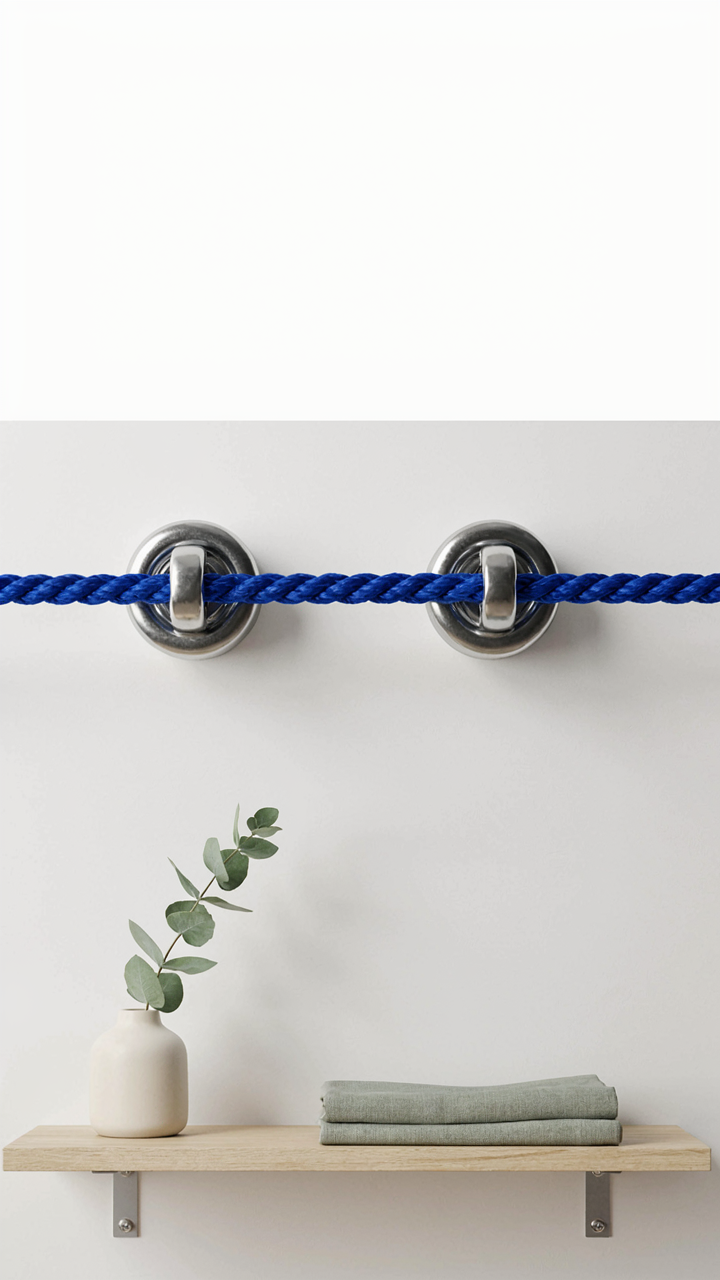
You want rope rails because they look authentic and you’re afraid of looking like you don’t know coastal design. Here’s the mechanism: a rope rail that moves will eventually kill someone. The engineering principle is redundancy—in structural systems, you build backup load paths so one failure doesn’t cascade. A rope rail has zero redundancy. One weak attachment point, one corroded eye bolt, one year of salt air, and the load transfers entirely to whatever fails next. Installation security is not optional detail. It is the entire system.

Coastal staircases demand fasteners rated for salt environments, which means stainless steel, never galvanized. You anchor rope rails every 16 to 18 inches along the run using through-bolts or lag bolts that bite into solid wood or structural blocking behind drywall. Surface-mounted fasteners on hollow walls fail in months. The rope itself must tension between anchor points tight enough that you cannot pull it more than a quarter inch sideways at midspan. Loose rope means the user’s hand never establishes contact with a true fixed rail. Test the installation before residents use it.
Natural Rope Versus Synthetic: Pick Based On Maintenance Reality
Most advice treats this as an aesthetic choice. It is not. This is an economics problem: natural rope costs less upfront but requires replacement every three to five years in coastal climates. Synthetic rope costs 30 to 40 percent more but lasts 15 to 20 years. The break-even point is around year seven, after which synthetic becomes the cheaper option when you count labor for reinstallation.
Natural fiber ropes like manila and sisal absorb salt spray and moisture, which promotes rot and mildew from the inside out. You cannot see the damage until the rope fails. Synthetic options like marine-grade polyester or polypropylene resist salt damage and dry quickly after humid periods. The cost difference over two decades matters less than the fact that you will replace synthetic rope zero times if you pick the right diameter and construction. Select a 3/4-inch diameter synthetic rope with UV protection already woven into the fibers during manufacturing, then inspect it annually for fraying at anchor points.
The Entropy Of Beach House Stairs: Accepting Imperfection

Worn Surfaces As Design Intent
You want permission to stop fighting decay. The wabi-sabi framework from Japanese aesthetics applies entropy directly to your staircase—the second law of thermodynamics states that disorder increases over time, and coastal cottage stairs prove it’s beautiful. Salt air, foot traffic, and moisture don’t degrade your stairs into failure; they document actual use. The worn edge isn’t a problem to fix. It’s evidence that the staircase functions.

Paint chips. Wood grays. Rope frays at the contact point where hands grip it daily. Most design advice tells you to prevent this or hide it. Wrong. The mechanism here is honesty—letting surfaces show what happens to them moves the visual weight away from perfection and toward authenticity. Your guests don’t trust polished. They trust worn.
Maintenance That Preserves Character
Maintenance without restoration is the actual skill. You’re not trying to keep stairs new; you’re trying to keep them safe and intentional about their aging process. A weathered painted tread still needs a solid substrate underneath—the decay you can’t see kills the staircase. The weathered look you see kills nothing.
Inspect for structural rot beneath painted surfaces every two years. Recoat treads when paint wears through to bare wood, not when they look imperfect. Rope rails need tension checked annually; fraying at the end is acceptable, but a loose rail is a liability. Paint your next coat in the same color or let it fade naturally—consistency in neglect beats random restoration.
Coastal Home Staircase Lighting: Beyond Ship Lanterns

Light As Structure, Not Decoration
You want lighting that signals good taste without screaming “I tried.” The real mechanism is this: light engineering is applied physics. You’re not placing fixtures—you’re controlling luminance ratios, which is the relationship between bright and dark zones that your eye uses to navigate safely and feel oriented. Most people skip the math and wonder why their staircase feels hostile or looks like a restaurant.

Coastal cottage stairs need two lighting layers that work in sequence. The first layer prevents stumbling: code requires minimum 10.76 lux on treads, which translates to enough light to see each step’s edge without strain. The second layer shapes mood by creating depth between risers and treads. Low-angle lighting across the steps does this efficiently. Recessed fixtures in the soffit or wall-mounted sconces at consistent intervals outperform centered overhead fixtures because they eliminate shadow pools where stairs disappear visually.
Ropes And Metals That Survive Moisture
Don’t mistake weathering for character. Most people pick fixtures based on how they look in photos, then panic when salt air corrodes them in two seasons. The fixture material matters more than the fixture shape. Marine-grade brass, stainless steel, and properly sealed aluminum are the only metals that hold up. Rope rails paired with these metals require regular maintenance protocols, not wishful thinking about coastal charm.
Fixture placement should acknowledge your rope rail’s position. If rope runs at 34 to 38 inches—standard handrail height—mount sconces 12 to 18 inches above the rail, angled downward at 30 degrees. This creates shadow definition on treads without glare off the rope fibers. Use warm color temperature LEDs between 2700K and 3000K; anything cooler looks institutional and flattens the visual depth you built with rope texture. The rope’s material—manila, cotton, or synthetic—reflects light differently, so test your fixture angle before committing.
The “Tide Proof” Coastal Stairs Design Method

Layered Defense Against Constant Wear
You want your staircase to look intentional and expensive without replacing it in five years. That fear drives the real decision here. Military strategy teaches layered defense: multiple barriers that fail independently so one breach doesn’t collapse the system. Your coastal staircase needs the same architecture. Salt air, moisture, UV exposure, and foot traffic don’t attack one at a time. They pile on simultaneously. Build resistance into each material layer separately so degradation stays localized and manageable.

The painted tread sits on top of the structural step, not integrated into it. The rope rail hangs independently of the balustrade frame. Even the substrate beneath paint gets its own protection strategy. When one layer fails, you replace that layer without gutting the whole staircase. This is how you avoid the amateur trap of choosing one “perfect” material that handles everything and fails completely when conditions shift.
Material Resilience For Longevity
Most cottage staircase advice focuses on aesthetics and skips material science entirely. Wrong move. Longevity depends on how each material responds to specific coastal conditions, not on how nice it looks in a photo. You need to know what actually degrades under salt spray, what swells with humidity, and what maintains dimensional stability when temperature swings. Pick materials that resist their specific enemies rather than materials you like the appearance of.
- Pressure Treated Pine For Stringers: Resists moisture infiltration and rot better than untreated wood. Salt air accelerates decay in standard framing, so the structural core needs chemical protection regardless of what you paint on top.
- Marine Grade Plywood For Treads: Void free construction prevents water from wicking into layers. Standard plywood delaminates in coastal humidity within two seasons of paint failure.
- Two Part Epoxy Paint: Bonds chemically to wood fiber rather than sitting on surface like latex. Salt spray and humidity break down standard latex paint bonds in under three years on high traffic stairs.
- Galvanized Steel For Hardware: Sacrificial zinc coating prevents rust when fasteners corrode. Stainless costs more upfront but outperforms galvanized long term in salt environments.
- Natural Fiber Rope With Synthetic Core: Jute or sisal wrapped around polyester rope resists UV and maintains grip while looking authentic. Pure natural rope degrades rapidly from sun exposure on south facing stairs.
The selection process stops being about preference and becomes about mapping material weakness to environmental threat. Salt spray attacks ferrous metals first. Humidity attacks wood glue bonds second. UV attacks rope fibers and paint pigment third. Match each material to defend against its specific threat, and your staircase survives coastal conditions without becoming a renovation project every few years.
Coastal Home Decor Stairs: When Less Is More
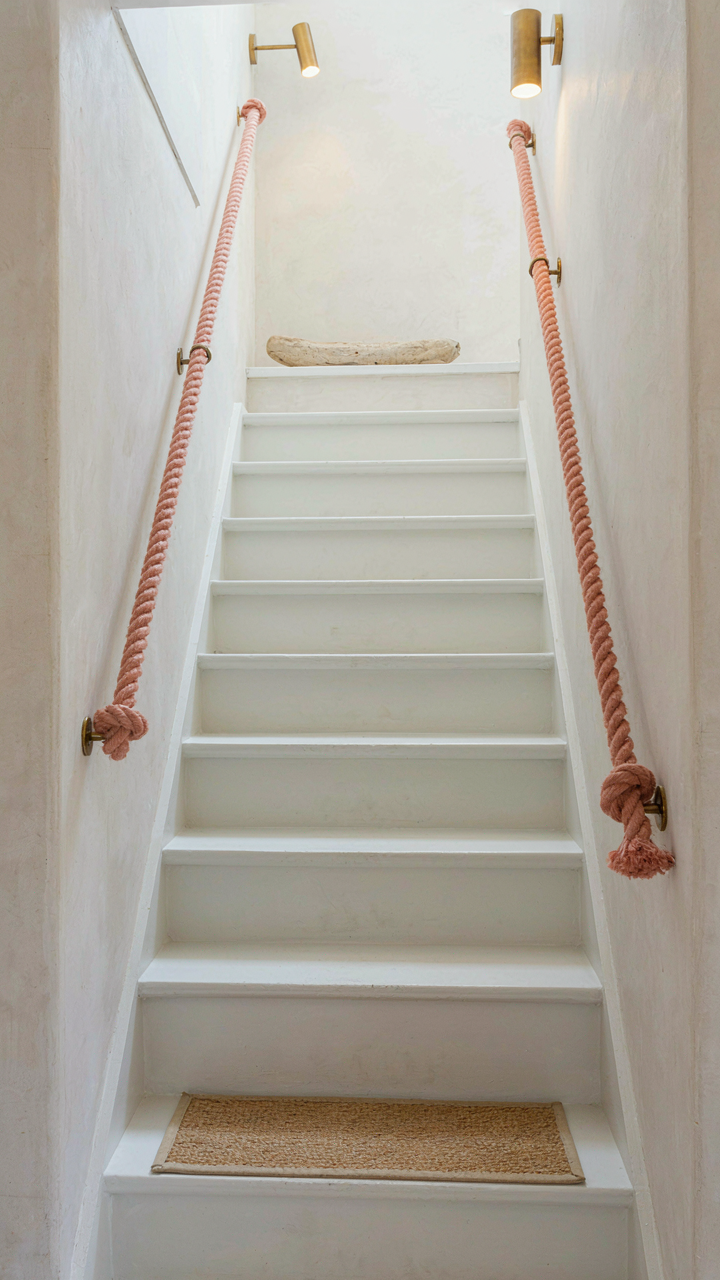
Clear The Stairwell First
You want your staircase to look intentional, not cluttered, because clutter signals that you’re not in control of your space. The mechanism is visual hierarchy: a staircase crowded with décor competes with itself and wins nothing. Your eye lands nowhere. The painted treads and rope railings already do the design work. Everything else is noise.

Start by removing what doesn’t serve the geometry of the stairwell. Most coastal cottages have narrow staircases. Tight quarters demand restraint. A single piece of driftwood or one framed nautical print on a landing works. Five items on the same wall create static. The rule isn’t about minimalism for its own sake. It’s about letting the structural elements you’ve chosen actually function as design.
The Difference Between Purpose And Accumulation
Coastal décor tempts you with souvenirs because travel and memory feel like legitimate reasons to fill space. They’re not. The difference between curated natural elements and souvenir overload is this: curated pieces relate to the staircase’s scale and material palette. A rope railing pairs with woven baskets or weathered wood. Accumulated souvenirs relate only to your trip. They don’t echo the staircase’s language.
Select pieces that share texture or tone with your painted treads and railings. A smooth stone from a beach you’ve visited works if it’s the right neutral shade and sits on a shelf without crowding. A collection of forty shell specimens does not. The selection process itself is the mechanism. You’re training your eye to recognize what belongs in this specific space, not what feels sentimental. Place only objects you can actually see and remember owning.
Beyond The Blue: Reclaiming Authentic Cottage Staircase Palettes

Where Coastal Colors Actually Come From
You want to feel like you own something real, not a mass-produced interpretation of coastal living. That’s the actual reason you care about historical color derivations. The mechanism is simple: authentic colors come from the materials and environment that shaped them, not from a designer’s mood board. Coastal cottages didn’t choose colors because they looked good together. They used what was available and what survived salt air, sun exposure, and the economics of 19th-century trade routes.
The colors you see in old cottage staircases trace back to pigment availability in specific regions. Ochres and iron oxides came from local earth. Indigo arrived through maritime commerce. Lime wash, the dominant finish on British and Scandinavian cottages, naturally took on the tones of the limestone and chalk used to make it. When you paint a staircase tread in a “coastal cottage” color without understanding its origin, you’re copying a copy. The real move is reverse-engineering which region your aesthetic actually pulls from, then sourcing pigments that match that lineage.
The Sun Does The Work You Can’t Control
Everyone talks about faded paint like it’s a design choice you can replicate with a brush technique. It isn’t. The fading in authentic coastal staircases isn’t aesthetic laziness or intentional distressing. It’s photochemical degradation specific to salt spray environments and UV intensity. Paint fades differently depending on exposure angle, humidity cycles, and whether the staircase sits in direct sun or protected shadow. A north-facing cottage staircase in Scotland fades at a completely different rate than a south-facing one in Cornwall.
The treads on working coastal cottage staircases show uneven fading because foot traffic polishes some areas while others remain protected under rope rails or shadow. This pattern is not reproducible with paint techniques. If you want authentic-looking faded tones, you have three options: use lower-opacity paint finishes that naturally lighten over time, accept that true authenticity requires actual time and exposure, or source reclaimed materials from demolished cottages where the fading is already complete and genuine.
The Unfinished Aesthetic: True Beach House Staircase Wisdom

Raw Materials Tell The Actual Story
You want your staircase to look effortlessly coastal because you’re afraid a polished one will expose how hard you tried. The mechanism at work here is honest material selection, which beats aesthetic theory every time. Coastal cottages survive salt air and weather because their builders chose materials that age visibly rather than hide damage. Reclaimed wood treads, untreated rope railings, and painted surfaces that show wear aren’t compromises. They’re the only logical choice when your environment is actively working against perfection.
The common advice here is garbage: people tell you to seal everything and maintain a curated appearance. That inverts how coastal architecture actually works. Weathered finishes on painted treads and naturally graying rope don’t look neglected. They look honest because they document the years of use and salt exposure your cottage has actually endured. Stop fighting entropy and start using it as your design partner instead.
Authenticity Beats The Instagram Version
The pitfall everyone falls into is treating unfinished aesthetics as a filter you apply to new materials. That’s the opposite of what works. A brand-new staircase painted to look “aged” with coffee and vinegar techniques reads as contrived instantly because it has no actual history. Coastal cottage staircases earn their character through real use, salt damage, and the consequences of honest material choices over ten years, not ten weeks.
The correct move is to source materials with existing patina and then maintain them without perfectionism. Painted treads naturally chip where foot traffic concentrates. Rope railings fray at touch points. These aren’t failures. They’re the documentation of a staircase doing its actual job in a salt environment. Accept visible wear as your design specification, not a problem to solve.
The Obstacle Isn’t Finding The Right Shade Of Seafoam; It’s Your Refusal To Engineer Within Genuine Constraints
You don’t need another inspiration board. You need to measure your actual staircase, price rope by the foot, and pick paint that survives salt air without your budget exploding. Stop waiting for the perfect coastal cottage staircase to materialize. Start with what you have. Order samples today and tape them to your treads under natural light. The difference between a stunning staircase and a failed Pinterest clone is one decision: you either build within reality or you build nothing at all.