The Unseen Psychology Of The Cottage Bay Window
Why You’re Actually Drawn To Bay Windows
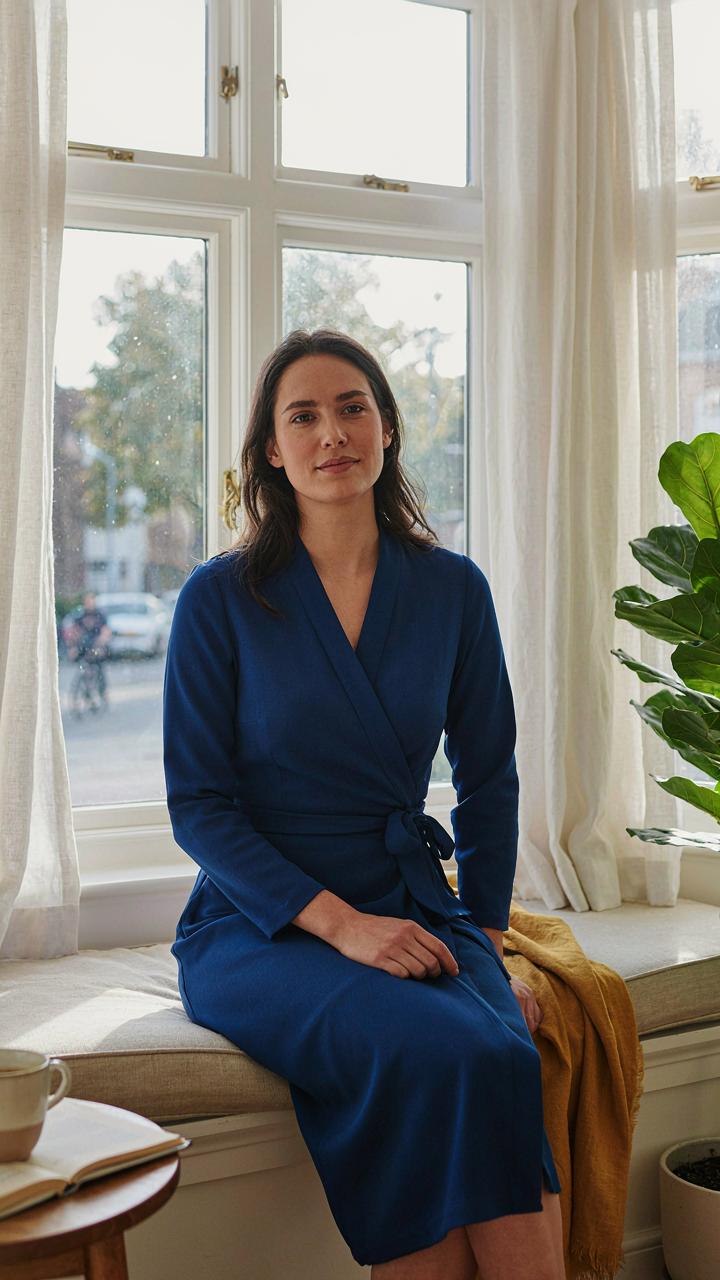
You want permission to sit alone without looking antisocial. That’s the real pull here, not aesthetics. Bay windows work because they operate as liminal space—territory between the interior and exterior that feels private while remaining visible. Architecture calls this the threshold condition. You occupy the bay but remain tethered to the home. The psychological payoff: observation without exposure. You watch the street, neighbors, weather, life—but the window frame creates enough distance that you’re not performing. That distance matters more than the view itself.
The cottage bay window became standard in Victorian and Edwardian homes precisely because builders understood this instinct. The protruding glass created a physical pocket where residents could retreat without fully leaving. Modern design treats bay windows as decorative elements. They’re not. They’re escape valves dressed in wood trim. The built-in seating amplifies this by eliminating the choice of what to do there. You sit. You observe. The space tells you its purpose. That certainty is what makes bay windows behaviorally magnetic across centuries and cultures.
The Shelter And Vantage Point Dynamic
Prospect-refuge theory from environmental psychology maps directly onto cottage bay window design: prospect is your ability to see outward, refuge is your ability to remain unseen. Bay windows maximize both simultaneously. You command visual range—the street, the garden, approaching visitors—while the depth and positioning of the window seat hide you from casual observation. It’s not coincidence that built-in seating always faces outward. The designer solved the mechanism before consciously naming it.
This dual function explains why bay windows feel fundamentally different from flat walls or standard windows. A standard window forces a choice: look out and be visible, or avoid the view. A bay window resolves the tension. The architectural pocket protects you while the glass grants you dominion. Refuge without isolation. That’s the exact condition humans optimize for in any environment we occupy regularly. When you design seating into a bay window, you’re not adding comfort—you’re crystallizing the psychological mechanism that made the space work in the first place.
Beyond “Cute”: The Deep Bay Window As A Power Hub

The Bay Window As Your Remote Work Station
You want a cottage bay window because it looks nice in photos. That’s not the real reason to build one. The actual mechanism is spatial hierarchy: a bay window creates a distinct zone within a room, which your brain treats as a separate territory. This separation is what lets focused work happen. A bay projects outward, capturing light from three angles instead of one wall. That’s not ambiance. That’s physics solving a work problem.

The depth matters more than the width. A shallow bay traps you in the room’s social space. A bay that projects 18 inches or more becomes a genuine work boundary. Seat height should position your eyes 24 to 30 inches from the window glass to avoid glare while keeping sightlines to outside. Built-in seating locked into this position means you’re not shuffling a chair around daily. The consistency trains your brain to enter work mode the moment you sit.
Hidden Systems For Power And Light
People install outlets in bay windows as an afterthought. Wrong move. This is the moment to run conduit and power before any wall closure happens. The real constraint is not adding outlets. It’s making them invisible so the space reads as retreat, not office. Route power through the floor cavity if possible. If walls are framed, surface-mounted conduit hidden behind cushions or trim works. Two outlets per seat minimum, positioned low so cords route downward and out of sight.
Lighting follows a hierarchy: ambient, task, accent. A bay window needs task light first because focused work demands it. Recessed fixtures aimed at the desk surface beat clip lamps or surface-mounted sconces that announce themselves. If built-in seating has a backrest, position wiring to support an integrated reading light mounted at spine height. Dimmers matter because morning sun changes the light equation entirely. Your task light should be controllable independently from room lighting so you can kill ambient glare during video calls without darkening the whole space.
The Bay Window Bench: A Behavioral Economics Approach
When Space Becomes The Anchor
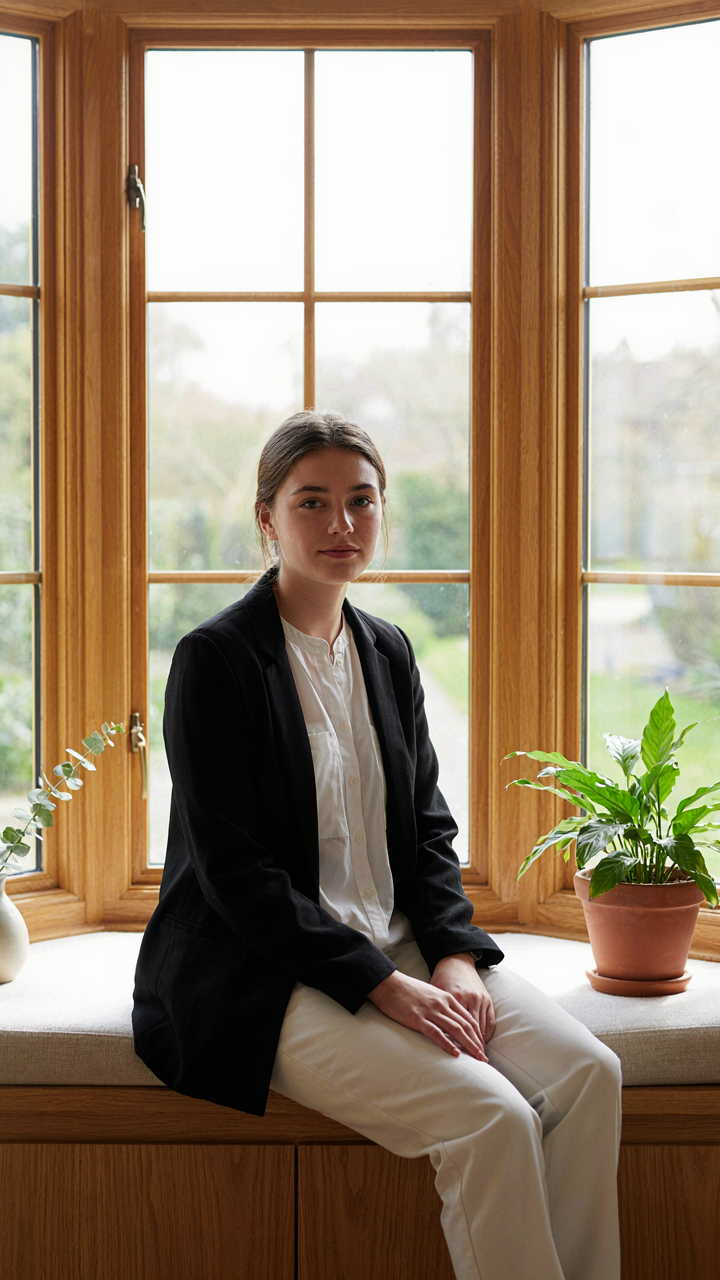
You want the bay window bench because it signals you own enough square footage to waste it on a single purpose. That’s the real driver. Here’s the mechanism: anchoring effect from behavioral economics works on physical space the same way it works on price. Your first impression of a room’s value locks in before rational thought arrives. A built-in bench anchors the bay window as a destination, not dead space. This shifts how visitors and you experience the entire room’s value upward. The bench doesn’t need to be comfortable or heavily used. It exists to establish the standard that this space deserves attention and design intention.

Most people think the bay window bench is decorative furniture. It’s not. It’s a framing device that anchors perceived value to everything around it. The bench resets what “normal” looks like in that corner. Once anchored, the entire bay becomes reference point for quality. Your eye stops treating it as wasted geometry and starts treating it as designed depth. This is why poorly executed benches feel like clutter and well-executed ones feel inevitable. The difference is whether the bench anchors upward or downward. Install it with purpose or skip it entirely.
The Constraint That Deepens Desire
Scarcity doesn’t mean rare materials or expensive finishes. It means restricting access to the experience. A bay window bench limits who can occupy that specific seat at that specific moment. In a room where seating sprawls across multiple zones, this concentrated restriction creates perceived value through simple math. You don’t want the bench because it’s functional. You want it because only three people can sit there at once while ten could use the rest of the room. That limit is what your brain registers as valuable.
The mechanism runs deeper than preference. Constraint forces intentional use instead of passive occupation. Someone chooses the bench instead of defaulting to it. That choice makes the bench feel earned rather than inevitable. Physical geometry combined with limited real estate produces the scarcity signal without artificial inflation. Your cottage bay window already has natural edges and boundaries. The bench leverages those constraints to make the space feel curated and finite. When you finalize the bench design, confirm it seats exactly two to three people maximum.
The Bow Window Blueprint For Social Alchemy
When Geometry Becomes Proximity
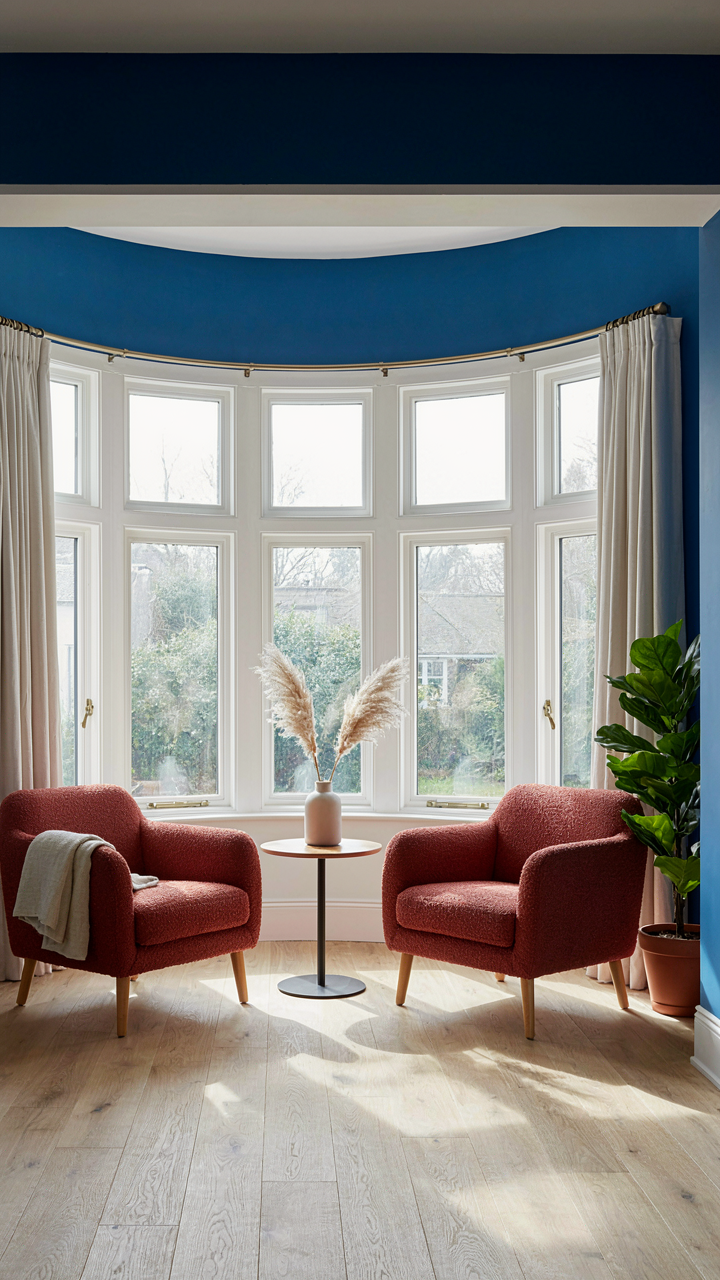
You want this because a bay window with built-in seating signals you have space, taste, and leisure. Here’s what actually matters: geometry controls conversation. A bay window juts into a room, creating a recessed nook. This physical separation from the main space mirrors what sociologists call “propinquity”—proximity breeds connection. Seating arranged inside a bay amplifies this. People naturally lower their voices, lean in, and stay longer. The semicircular or polygonal shape itself forces people to face each other instead of sitting shoulder-to-shoulder. Distance collapses.

Built-in seating removes the cognitive load of choosing where to sit. No scanning the room. No awkward standing. The bay window becomes a social container that does the work for you. Cushions, proper depth, and arm heights matter because they telegraph comfort. A shallow bay window seat reads as decorative. A properly proportioned one—at least 24 inches deep with back support—reads as functional and inviting. The furniture layout should pull people into the bay, not push them away from it.
How Interruption Becomes Connection
Most design advice says bay windows create “gathering spots.” That misses the point. Bay windows interrupt normal room traffic patterns, forcing people to choose to enter the space. This choice matters. In sociology, this is friction that builds investment. Someone sitting in a bay window seat isn’t there by accident. They’ve made a micro-commitment. Others notice. They follow.
The best bay window seating faces outward into the main room, not inward at the walls. This positions seated people as observers and conversationalists simultaneously. Place a small table or console perpendicular to the seating so standing guests have a reason to approach. A cottage bay window becomes the room’s focal point not through decoration but through intentional placement. The mechanism is simple: design removes friction from showing up, which increases probability someone will stay.
Window Design As A Cognitive Filter

Natural Light Positions Your Brain For Focus
You want this section because you sense productivity happens in certain rooms and not others, and you’re right to feel that gap. The mechanism is simple: light intensity and angle directly regulate circadian rhythm synchronization and cortisol timing. A cottage bay window doesn’t just add brightness. It delivers directional light at specific times of day, which trains your nervous system to enter focus states when you sit in that spot.

South-facing bay windows in the Northern Hemisphere flood spaces with consistent midday light, which suppresses melatonin production and sharpens alertness during peak working hours. East-facing bays front-load morning light exposure, which anchors your circadian cycle earliest and produces the strongest cognitive gains. Position your work surface perpendicular to the bay, not facing it directly. Direct glare into your eyes kills focus. Angle it so light falls across your work surface from the side at roughly 45 degrees.
External Views As Attention Architecture
Common advice says views relax you. Incomplete. Views work like visual bookmarks for your attention span. When your mind fragments during deep work, an uncluttered external view gives your eyes a recovery point that doesn’t derail your mental state. A cottage bay window frames this boundary between internal focus and external reset more deliberately than a flat wall window because the recessed geometry contains the view.
The cottage bay’s three-panel structure naturally creates a foreground, middle ground, and background. Use this depth. Plant low shrubs or garden features in the immediate foreground so your gaze has a stopping point that doesn’t push all the way to the horizon. Your eyes need a focal plane roughly 20 feet out to genuinely reset without losing mental continuity. Ensure the middle distance contains no motion or distraction, only static landscape elements. This setup takes five minutes to map out on paper before planting anything.
The Cottage Bay Window Seating Protocol
How Your Body Actually Stays Put
You want this to look effortless because you think comfort is passive. It isn’t. Ergonomics borrows from biomechanics—the study of how force moves through structures—and a bay window seat is a load-bearing system for your spine, not a decoration. When you sit for hours, your lumbar spine demands specific angles or it rebels. The seat depth, back angle, and arm height aren’t aesthetic choices. They’re mechanical requirements your body enforces whether you acknowledge them or not.

Most bay window seating advice ignores this entirely and treats sitting like a static pose. Wrong. Your body needs micro-movement options or it locks up. Seat depth between 16 and 18 inches keeps your feet planted without jamming your knees into the back cushion. Back support angled at 100 to 110 degrees from the seat surface prevents slouching while allowing your spine to maintain its natural curve. Armrests at elbow height reduce shoulder strain during extended reading or work. These aren’t recommendations. They’re thresholds where comfort switches to pain.
- Seat depth: 16 to 18 inches prevents knee jamming and keeps feet grounded for stability during long sessions.
- Lumbar support: A firm cushion or built-in curve at lower back height prevents slouching and spinal fatigue.
- Back angle: 100 to 110 degrees supports natural spine curvature without forcing reclined posture.
- Armrest height: Positioned level with your elbows reduces shoulder strain and supports arm weight.
- Cushion density: High-density foam holds shape under repeated use and maintains support consistency over years.
The mechanism is simple: measure your own body before building. Sit in a standard dining chair and measure the distance from the back of your thighs to the back of the chair. That’s your seat depth baseline. Measure from your seat to your elbows when your shoulders relax. That’s your armrest height. Transfer these numbers to your bay window design. Comfort isn’t discovered after installation. It’s engineered before the first nail goes in.
The Mental Load Lives In Clutter
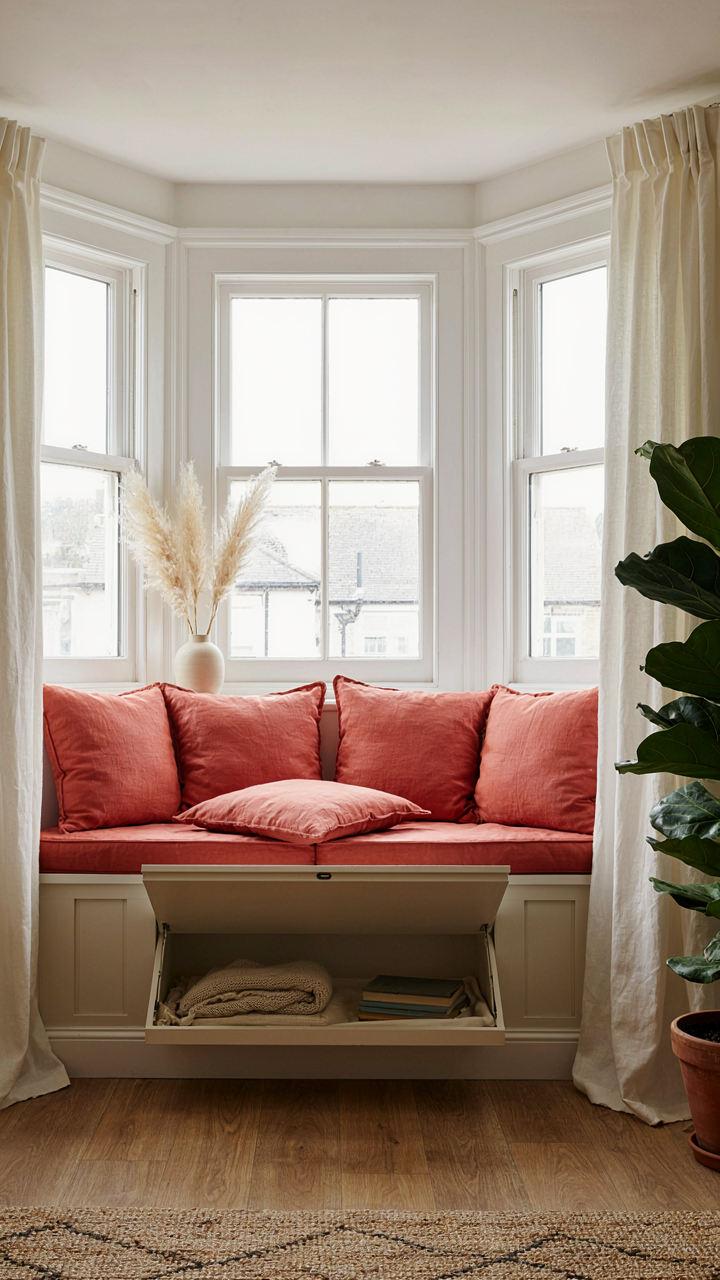
Storage built into cottage bay window seating solves a problem that has nothing to do with space. It solves decision fatigue. Every object in your visual field demands a micro-decision from your brain: acknowledge it, categorize it, decide if it matters. Bay window seating without storage becomes a landing zone for blankets, books, throw pillows, and whatever else drifts in. The seat stops functioning as a place to sit and starts functioning as a place to move things from.
Built-in storage compartments under or beside the seating eliminate this tax. Lift-top mechanisms work best because they hide items completely and access happens in one motion, not seven. Deep shelving on either side of the window frame works if you commit to consistent organization. The real mechanism isn’t about having less stuff. It’s about removing objects from your active visual environment so your brain stops processing them during the hours you sit there. The fewer decisions your mind makes during your time in the bay window, the more presence you actually have.
Deconstructing Bay Window Decor: Less Is More Impact
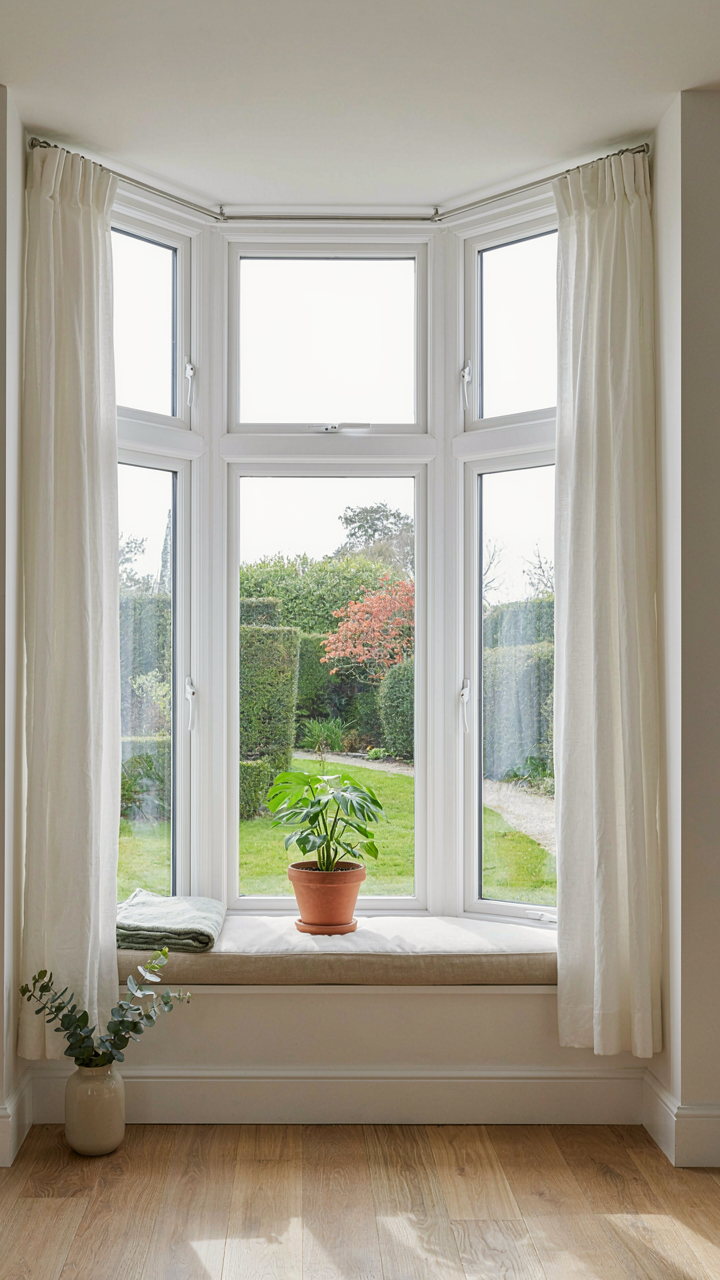
When Restraint Becomes The Statement
You’re worried that an empty bay window looks unfinished, like you didn’t try hard enough. That’s the real problem here. In design physics, a bay window functions as a focal point concentrator—it naturally draws the eye and amplifies whatever occupies it. Overloading it with objects doesn’t strengthen that focal point. It diffuses it. The mechanism is simple: constraint creates emphasis. A single well-chosen object in a bay window commands attention. Ten objects scatter it across the room.

The cottage aesthetic doesn’t require clutter to read as authentic. Historical cottage interiors were sparse by necessity, not design choice. A bay window with clear sightlines to the exterior garden, a single potted plant on the built-in seat, and unobstructed natural light does more work than a staged arrangement of decorative objects. Strip the bay window to its functional core: the view, the light, the seating. Everything else competes for visual authority it doesn’t deserve.
Ditching The Pinterest Trap
The common advice says “layer textures and fill the space.” That’s wrong. Most cottage bay window décor fails because it treats the space like a shelf to merchandise objects rather than an architectural feature to inhabit. The pitfall is treating the bay as scenery instead of a functional zone. When you add throw pillows, blankets, books, candles, and decorative boxes, you’re not enhancing the space. You’re obscuring the reason the bay window exists—to frame light and views while providing a place to sit.
Avoid symmetrical arrangements and matching pairs. They signal forced design rather than lived-in authenticity. The real aesthetic move is honest emptiness interrupted by one element of actual use. Keep the built-in seat clear except during active occupancy. Place a single item on the windowsill only if it serves a purpose: a plant that needs light, a book actively being read, a glass of water. When visitors ask why the bay window looks so uncluttered, you’ll know the restraint worked.
The Unspoken Power Of Your Bay Window: Beyond Instagram
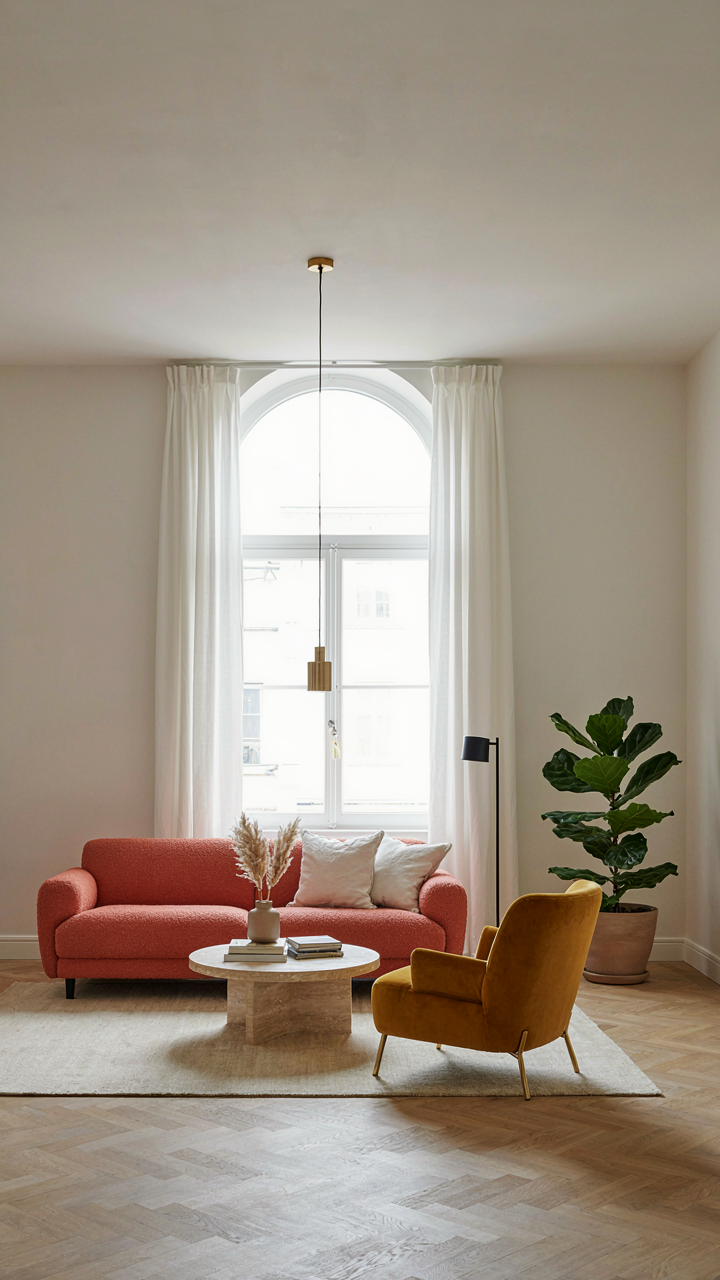
Property Value Isn’t Why You Actually Want This
You want a bay window because you think it’ll move the needle on your home’s resale price. It won’t, not directly. Homes sell on location, condition, and square footage. A bay window is a peripheral upgrade that buyers notice only after those factors already check out. The real mechanism is different: a bay window shifts your daily utility patterns, which means you occupy your home differently, which means you actually use the space you paid for instead of walking past dead zones.

Real estate economics treats bay windows as aesthetic additions. They’re not. They’re occupancy infrastructure. When you add built-in seating into a bay window, you create a functional anchor point that pulls you into that room repeatedly. That’s the mechanism that moves value: not the appraisal bump, but the behavioral shift that makes you defend the property because you’ve actually integrated it into your routine. The difference between a house and a home is use frequency.
How Your Space Shapes Your Actual Behavior
Bay windows with built-in seating don’t just look different, they rewire your movement through the house. Behavioral economics calls this “choice architecture”—the way physical design narrows your options and pushes you toward specific actions. Your bay window with seating becomes a gravitational point. Instead of defaulting to the couch in the living room, you now have a competing focal point with natural light, a view, and tactile separation from the main room.
Over months and years, this compounds. You read there instead of in the bedroom. You take calls there. You watch the weather from there. Morning coffee happens there. These aren’t big decisions, which is precisely why they stick. Your brain stops deliberating and just goes to the seating. That accumulated time—hours per week, thousands per year—becomes the actual value. You’re not buying a bay window. You’re buying a behavioral redirect that makes your home function like it was designed for how you actually live.
The Real Obstacle Isn’t A Lack Of Ideas, But A Fear Of Designing For Intention, Not Just Trends
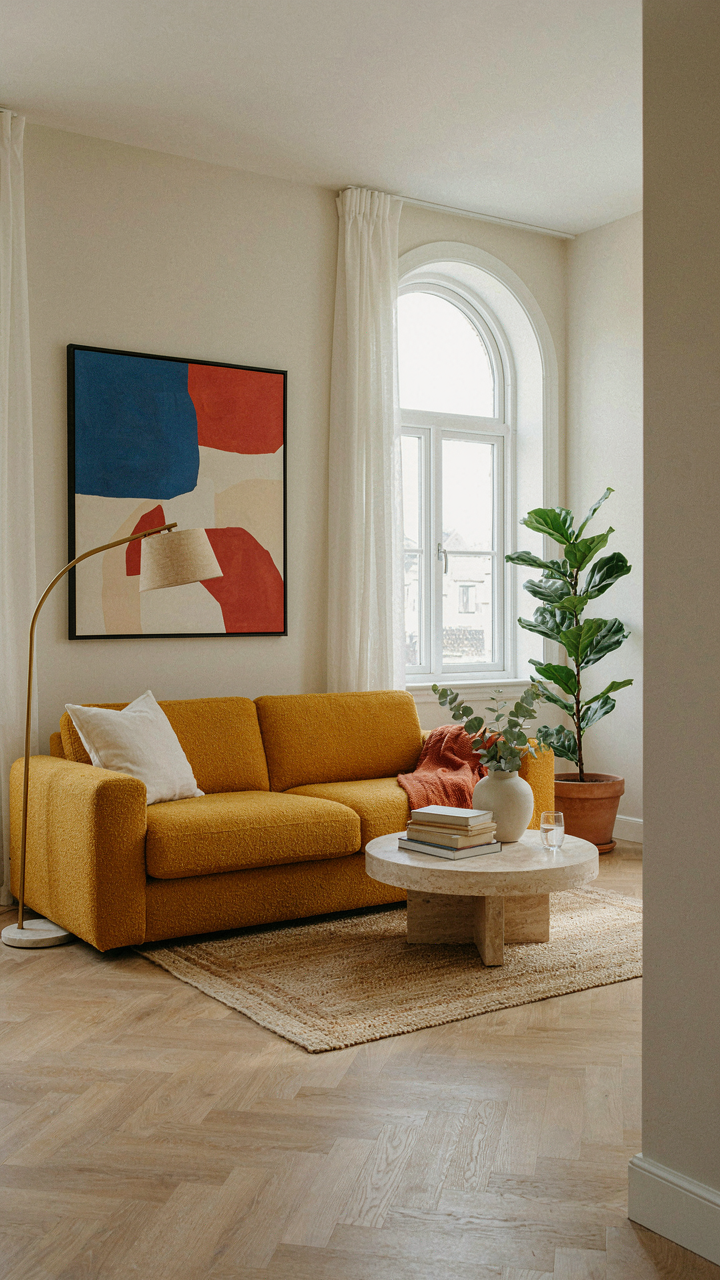
Most people buy a cottage bay window and fill it with whatever looks nice in photos. They miss the point entirely. Your bay window solves a specific problem in your life: you need a reading spot, a meditation corner, or a place to watch the world. Define that first. Then design backward. Skip the Pinterest rabbit hole and ask yourself what you actually do in that space. Your cottage bay window becomes remarkable when it serves you, not when it serves Instagram. Stop collecting ideas and start collecting intentions.